📌 Key Points
- Yes, you can sometimes replace only the outdoor unit: Existing R-410A systems can still be repaired with compatible R-410A condensing units, including service components made since January 1, 2025, that are labeled for servicing existing equipment only.
- It is not limited to leftover R-410A inventory: EPA allows R-410A service components to continue being manufactured and imported for repairing existing systems, and there is no federal sell-by date for those components.
- New refrigerants cannot simply be mixed with old equipment: An R-454B or R-32 outdoor unit cannot be installed onto an R-410A indoor coil that was not designed for that refrigerant.
- The equipment still has to be compatible: Refrigerant, capacity, controls, metering device, efficiency, manufacturer requirements, and Florida’s applicable DOE efficiency rules all matter when replacing one side of a split system.
- AHRI ratings belong to combinations: The SEER2, EER2, and capacity rating of a split system is based on a specific indoor-and-outdoor equipment combination, not the outdoor condenser by itself.
- Age changes the economics, not the legality: A condenser-only repair may make sense on a younger, healthy system. On older equipment with coil, comfort, efficiency, or repair-history concerns, comparing full replacement is usually worthwhile.
Yes, you can still replace only the outdoor AC unit in some Central Florida homes in 2026. The answer depends mainly on what refrigerant your existing system uses, whether a compatible replacement condensing unit is available, whether the resulting system meets applicable efficiency and manufacturer requirements, and whether repairing only half the system makes financial sense.
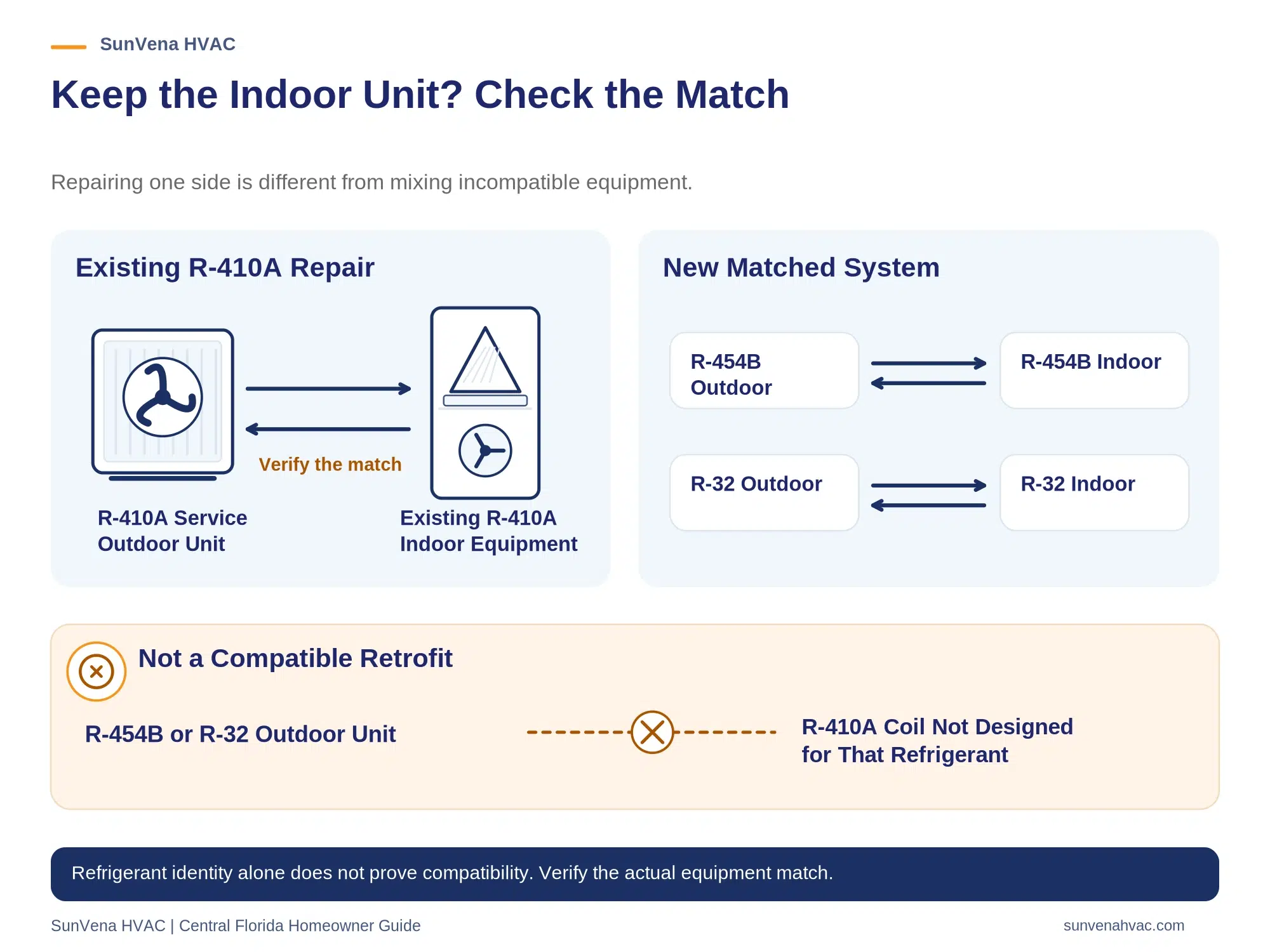
The biggest misconception in 2026 is that the R-410A transition eliminated condenser-only replacement. It did not. EPA specifically allows existing R-410A systems to be repaired with R-410A condensing units, indoor coils, compressors, and other service components. Those components can continue to be manufactured and imported after 2025 when they are labeled for servicing existing equipment.
What you generally cannot do is take a new R-454B or R-32 outdoor unit and connect it to an existing R-410A indoor coil. Those refrigerants and the equipment designed around them are not interchangeable.
Can You Replace Just the Outdoor AC Unit in 2026?
Sometimes. There are three common situations.
| Situation | Can the Outdoor Unit Potentially Be Replaced Alone? | What Matters |
|---|---|---|
| Existing R-410A system with a failed outdoor unit | Yes | A compatible R-410A service condensing unit must be available and appropriate for the existing indoor equipment and installation. |
| Existing R-410A indoor coil with a new R-454B or R-32 outdoor unit | No, not as a normal equipment pairing | A2L refrigerants and their systems have different design and safety requirements and cannot be substituted into equipment not designed for them. |
| Older system where both major sections need replacement | Usually treated as a new system | Current refrigerant rules, efficiency standards, equipment matching, sizing, and installation requirements apply to the new system, subject to the remaining pre-2025 inventory exception described below. |
EPA’s current HFC phasedown guidance specifically says homeowners can replace a failed R-410A condensing unit, indoor coil, compressor, or other component with a similar R-410A component and continue repairing the system throughout its useful life.
Did the Refrigerant Transition End R-410A Condenser-Only Replacement?
No. This is the most important 2026 correction.
EPA separates repairing an existing system from installing a new system. Those are not treated the same way under the Technology Transitions rules.
Repairing an Existing R-410A System
R-410A condensing units, compressors, evaporator coils, and other components can continue to be manufactured and imported for servicing existing R-410A equipment. Components manufactured or imported after January 1, 2025 must carry service-only labeling when required by EPA.
EPA also states that there is no date when R-410A service condensing units can no longer be sold. That means condenser-only repair is not limited by federal law to whatever old units happen to remain in distributor warehouses.
Actual availability can still become an issue for a specific model, capacity, voltage, efficiency level, or equipment family. A manufacturer does not have to keep producing every legacy match indefinitely. But that is a product-availability issue, not a federal ban on R-410A repair components.
Installing a New R-410A System
The rules are different when both the outdoor condensing unit and indoor evaporator coil are replaced as a new system. New residential equipment has transitioned toward refrigerants below EPA’s 700 global warming potential limit, most commonly R-454B and R-32.
There is an important 2026 exception. EPA’s May 2026 final rule (91 FR 31284) removed the January 1, 2026 installation deadline for qualifying residential and light-commercial equipment using higher-GWP refrigerants when the specified equipment was manufactured domestically or imported before January 1, 2025. As a result, qualifying pre-2025 R-410A system inventory can continue to be installed until that inventory is exhausted.
This pre-2025 inventory exception is separate from the service-component rule. For a deeper explanation, see SunVena’s R-410A phase-out guide for Florida homeowners.
Can You Put an R-454B or R-32 Condenser on an R-410A Indoor Coil?
No, not as a normal retrofit.
R-454B and R-32 are classified as A2L refrigerants, meaning they have lower flammability than traditional highly flammable refrigerants but still require equipment designed and listed for their specific safety characteristics. Equipment that uses R-454B or R-32 is designed, tested, and safety-listed for that refrigerant, so neither can be added to or paired with R-410A components.
The differences extend beyond the name on the refrigerant cylinder. Equipment can differ in:
- Refrigerant properties and operating characteristics
- Pressure and temperature relationships
- Compressor and lubricant requirements
- Metering devices
- Controls and sensors
- Refrigerant detection and mitigation requirements where applicable
- Service procedures and tools
- Equipment listings, labels, and manufacturer approvals
If an existing R-410A system needs only one major component, the appropriate repair path is generally a compatible R-410A service component, not converting half the system to R-454B or R-32.
Why Does the Indoor and Outdoor AC Equipment Need to Match?
A split-system air conditioner is evaluated as a combination of indoor and outdoor equipment. The outdoor condenser alone does not determine the system’s SEER2, EER2, cooling capacity, or other certified performance.
The Air-Conditioning, Heating, and Refrigeration Institute (AHRI) certifies performance ratings for specific equipment combinations. The AHRI Directory lists the indoor unit, outdoor unit, capacity, SEER2, EER2, and other applicable performance data associated with a certified combination.
That does not mean every component replacement is automatically impossible unless the equipment is the same age or model family. It means the contractor needs to verify that the proposed replacement is an appropriate system combination and that its rated performance and installation comply with applicable requirements.
For a condenser-only replacement, ask the contractor:
- Is this outdoor unit approved or documented for use with my existing indoor coil or air handler?
- What is the resulting system’s certified or manufacturer-rated capacity and efficiency?
- Does the combination comply with the DOE efficiency standard applicable in Florida?
- Does the manufacturer support the combination?
- What warranty applies to the new outdoor unit and the remaining indoor equipment?
What Efficiency Rules Apply to an Outdoor AC Replacement in Florida?
Florida is part of the U.S. Department of Energy’s Southeast region for split-system central air conditioners. DOE regional efficiency standards are based on the installed equipment in the Southeast, not merely when the outdoor unit was manufactured.
Under the current standards, split-system central air conditioners installed in the Southeast generally must meet at least:
- 14.3 SEER2 for systems with cooling capacity below 45,000 Btu/h
- 13.8 SEER2 for systems with cooling capacity of 45,000 Btu/h or greater
DOE’s regional central-air-conditioner guidance explains that systems installed in the Southeast must comply with the regional standard. A contractor should verify that a replacement outdoor unit can be installed in a compliant configuration with the remaining indoor equipment.
Heat pumps are governed by nationwide efficiency requirements rather than the Southeast central-air-conditioner regional standard, so the exact compliance analysis depends on whether the home has a straight-cool air conditioner or a heat pump.
Will Replacing Only the Outdoor Unit Void the Warranty?
Not automatically. Warranty coverage depends on the manufacturer, equipment, installation, and specific warranty terms.
Some manufacturers require indoor and outdoor equipment to be properly matched for particular system or component warranties. Other coverage may apply separately to individual replacement components. Rebates, efficiency certifications, and extended coverage may also require a documented AHRI-rated combination.
For example, Daikin requires online registration within 60 days for its 12-year parts limited warranty. Check the warranty documents for your exact models, because other manufacturers use different language and conditions.
Before approving a condenser-only replacement, ask for the following in writing:
- The model number of the replacement outdoor unit
- The existing indoor coil or air-handler model number
- The applicable AHRI reference number or manufacturer compatibility documentation when available
- The warranty on the replacement condenser and compressor
- Any effect on the remaining indoor-unit warranty
- Any labor warranty from the installing contractor
Do not accept a blanket statement that “the warranty is fine” or “the warranty is void” without checking the actual terms for the equipment involved.
When Does Replacing Only the Outdoor AC Unit Make Sense?
A condenser-only replacement can be a reasonable repair when several of these factors line up:
- The indoor equipment is relatively young and in good condition
- The existing system has not had recurring evaporator-coil or refrigerant leaks
- A compatible R-410A service condensing unit is available
- The combination meets applicable efficiency and installation requirements
- Warranty coverage makes the outdoor replacement financially attractive
- The blower, indoor coil, controls, and duct system are performing well
- The home is comfortable and humidity control was satisfactory before the failure
- The all-in condenser replacement cost is meaningfully lower than a properly designed full-system replacement
A failed compressor inside the outdoor unit does not always mean the entire condensing unit must be replaced either. Depending on equipment age, warranty status, diagnosis, and labor cost, replacing the compressor itself may be another repair option.
When Does Full AC Replacement Make More Sense?
Replacing the complete system deserves a closer look when the outdoor failure is only one part of a broader aging-equipment problem. Our repair-or-replace guide for Central Florida walks through the full decision.
Factors that strengthen the replacement case include:
- The indoor coil or air handler is more than 10 years old and other replacement signals are present
- The system has a history of refrigerant leaks or major repairs
- The evaporator coil shows corrosion or deterioration
- The indoor blower, controls, or other components are also approaching significant repair costs
- The home has persistent humidity, airflow, noise, or temperature-balance problems
- No appropriate or economically sensible service condenser is available
- The existing equipment combination limits efficiency or comfort improvements you want
- The full-system replacement carries substantially stronger warranty coverage
- The cost difference between the two options is small enough that keeping the older indoor equipment offers limited long-term value
ENERGY STAR recommends considering replacement when an air conditioner or heat pump is more than 10 years old, particularly when repairs are becoming frequent, energy bills are rising, or comfort problems are developing. Ten years is an evaluation point, not an automatic replacement deadline.
Is an Old Indoor Coil Guaranteed to Fail Soon After a New Condenser?
No. Age increases the importance of evaluating the remaining equipment, but there is no reliable rule that an older evaporator coil will fail within a certain number of years after an outdoor-unit replacement.
The indoor coil and air handler have accumulated operating time and environmental exposure along with the outdoor equipment, but each component has different failure modes. A 10- or 12-year-old coil may continue operating for years, or it may develop a leak relatively soon. Its condition, corrosion history, installation quality, condensate environment, previous repairs, and equipment design all matter.
This is why the decision should be based on inspection and economics rather than assuming the old half is either “perfectly good” or “about to fail.”
How Should You Compare the Cost of a Condenser-Only Repair With Full Replacement?
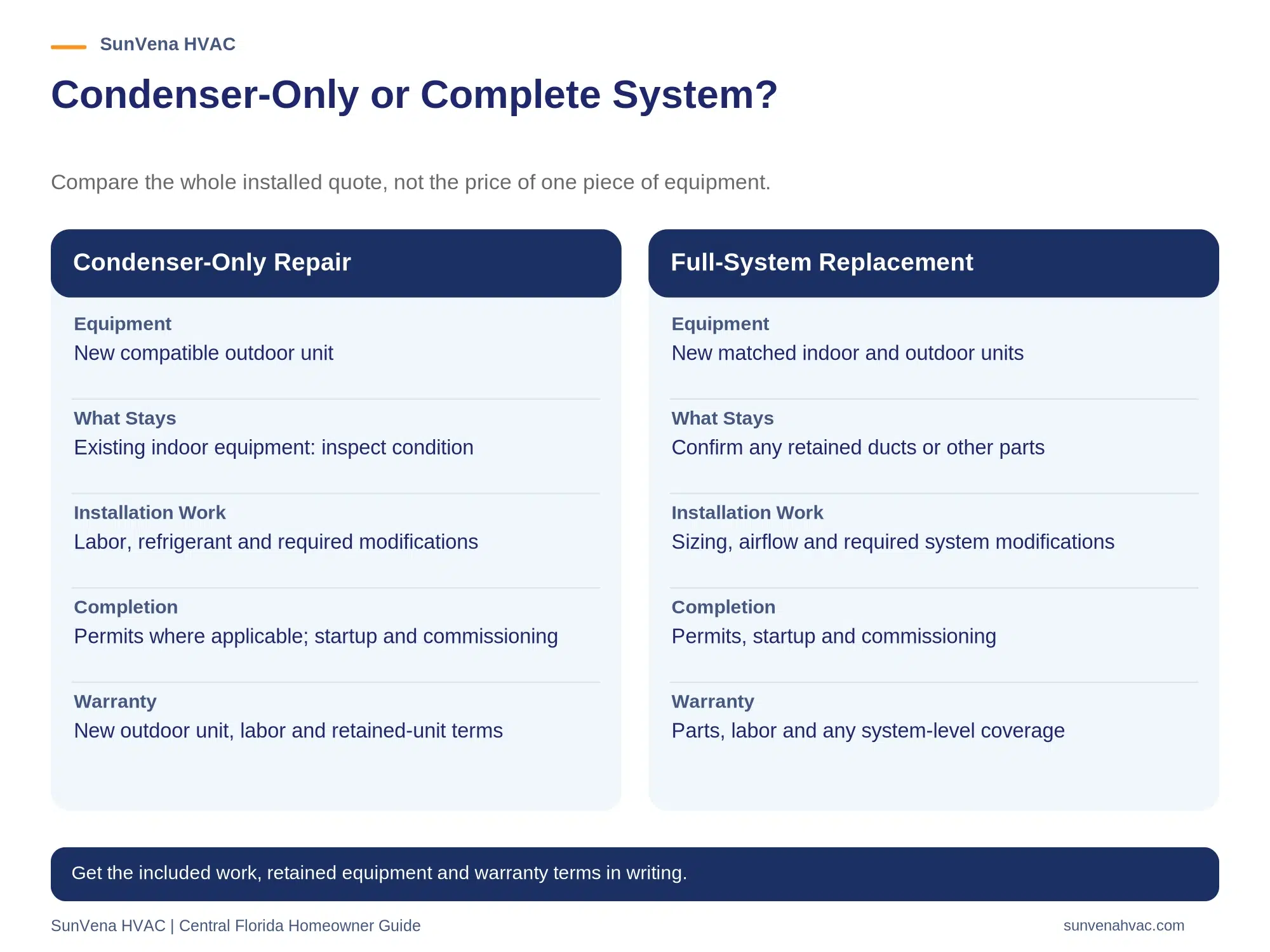
Compare complete installed prices, not equipment prices.
What the Condenser-Only Quote Should Include
- Replacement condensing unit
- Labor
- Refrigerant recovery and charging
- Required refrigerant and materials
- Electrical or control modifications
- Any metering-device or compatibility changes
- Permitting where applicable
- Startup and commissioning
- Parts and labor warranty
- Documented equipment compatibility and efficiency
Ask the Full-System Quote to Include:
- Outdoor unit and indoor coil or air handler
- Appropriate system sizing rather than automatically copying the old tonnage
- Duct and airflow evaluation where needed
- Electrical and condensate modifications
- A2L refrigerant safety requirements for applicable new equipment
- Removal and disposal of the old equipment
- Permits
- Startup and commissioning
- Complete parts and labor warranty terms
SunVena’s AC installation and replacement service explains the options available for Central Florida homes. If the existing system may only need a major repair, start with an AC diagnostic and repair evaluation before assuming full replacement is necessary.
What Changed in 2026 for Homeowners With R-410A Systems?
Two separate rules are easy to confuse:
- R-410A service components remain available for repairs. EPA permits manufacturers and importers to continue supplying R-410A condensing units, compressors, evaporators, and other components for servicing existing systems. There is no federal deadline requiring those service components to disappear.
- Qualifying pre-2025 complete R-410A inventory received a longer installation runway. EPA’s May 2026 final rule removed the previous January 1, 2026 installation deadline for qualifying equipment manufactured domestically or imported before January 1, 2025. That specific inventory can continue to be installed until supply is exhausted.
Those rules mean that the transition to R-454B and R-32 is real, but the market did not suddenly make every R-410A outdoor-unit failure a mandatory full-system replacement.
How Do You Decide Step by Step?
- Identify exactly what failed. A compressor failure, condenser-coil leak, fan motor, contactor, control board, and lightning-damaged unit can produce very different repair options.
- Record the indoor and outdoor model numbers. Compatibility cannot be evaluated reliably from tonnage or brand name alone.
- Confirm the refrigerant. Determine whether the existing system uses R-410A, R-22, R-454B, R-32, or another refrigerant.
- Check existing warranty coverage. A covered compressor or outdoor unit can dramatically change the economics.
- Ask whether an appropriate service replacement exists. If the system is R-410A, do not assume service condensers are prohibited or limited to old inventory.
- Verify the match and Florida efficiency compliance. Ask for AHRI or manufacturer documentation when applicable.
- Inspect the indoor half. Evaluate the evaporator coil, blower, controls, drain system, airflow, and repair history rather than assuming age alone determines condition.
- Price both options when the decision is close. Compare a complete condenser-only repair with a properly designed full-system replacement.
- Compare warranties and expected ownership. The value of a new full-system warranty is different for a homeowner staying 10 years than for someone planning to move soon.
- Choose the option that solves the actual problem. A younger healthy R-410A system may be an excellent condenser-only repair candidate. An older system with several developing problems may justify replacing both sides at once.
Frequently Asked Questions
Can I replace just my R-410A outdoor AC unit in 2026?
Yes, if an appropriate R-410A service condensing unit is available and the proposed installation is compatible and compliant. EPA explicitly allows R-410A condensing units to continue being manufactured, imported, sold, and installed for servicing existing R-410A systems.
Are R-410A replacement condensers only leftover inventory?
No. This is an important distinction. Pre-2025 complete-system inventory is finite, but R-410A components intended to repair existing equipment can continue to be manufactured and imported after 2025. EPA requires specified newer service components to be labeled for servicing existing equipment only.
Can I connect an R-454B condenser to an R-410A evaporator coil?
No. R-454B is an A2L refrigerant, and equipment that uses it is designed, tested, and safety-listed for that refrigerant, so it cannot be paired with R-410A components. A new R-454B outdoor unit requires equipment designed and approved for that refrigerant.
Can I connect an R-32 condenser to an R-410A indoor coil?
No. The same principle applies to R-32. It is also an A2L refrigerant and cannot simply be substituted into an R-410A system that was not designed for it.
Does the replacement condenser have to be the same brand?
Brand alone does not determine compatibility. The contractor needs to verify that the specific indoor and outdoor models are approved or otherwise appropriately documented as a system combination, meet applicable efficiency rules, and satisfy manufacturer requirements. In many situations, staying within the manufacturer’s supported combinations is the practical path.
Does a mismatched indoor and outdoor AC automatically void every warranty?
No universal rule applies to every manufacturer and warranty. Some warranties require proper equipment matching for specific coverage, while component warranties and contractor labor warranties can have different terms. Review the actual warranty documents for both the existing and replacement equipment.
Will an old evaporator coil fail if I replace only the condenser?
Not necessarily. The older indoor equipment has accumulated age and operating exposure, but no rule predicts when it will fail. Have the coil and air handler evaluated for leaks, corrosion, airflow, controls, and overall condition before deciding.
Should I replace the entire AC if the system is more than 10 years old?
Not automatically. ENERGY STAR identifies 10 years as a point when homeowners should consider replacement, especially when repair frequency, energy costs, or comfort problems are increasing. A modest or warranty-supported repair can still make sense on an older system that is otherwise performing well.
Condenser Replacement or Full AC Replacement in Central Florida
If your outdoor AC unit has failed, SunVena HVAC can determine whether the problem can be repaired, whether a compatible condenser-only replacement is available, or whether replacing the complete system provides better long-term value.
SunVena HVAC serves homeowners across Greater Orlando and Volusia County and works with R-410A systems as well as current-generation lower-GWP equipment. For diagnosis, visit AC repair services. If full replacement is worth comparing, review AC installation and replacement options.
To have the system evaluated, schedule HVAC service online or call (321) 621-5156.