📌 Key Points
- Refrigerant is not fuel: A properly charged air conditioner should not normally need refrigerant added as routine maintenance. If a system that was correctly charged has lost refrigerant, a leak is the likely reason.
- Low charge is a diagnosis, not a symptom: Warm air, long runtimes, ice, and high humidity can occur with refrigerant problems, but they also overlap with airflow, coil, blower, duct, and control problems.
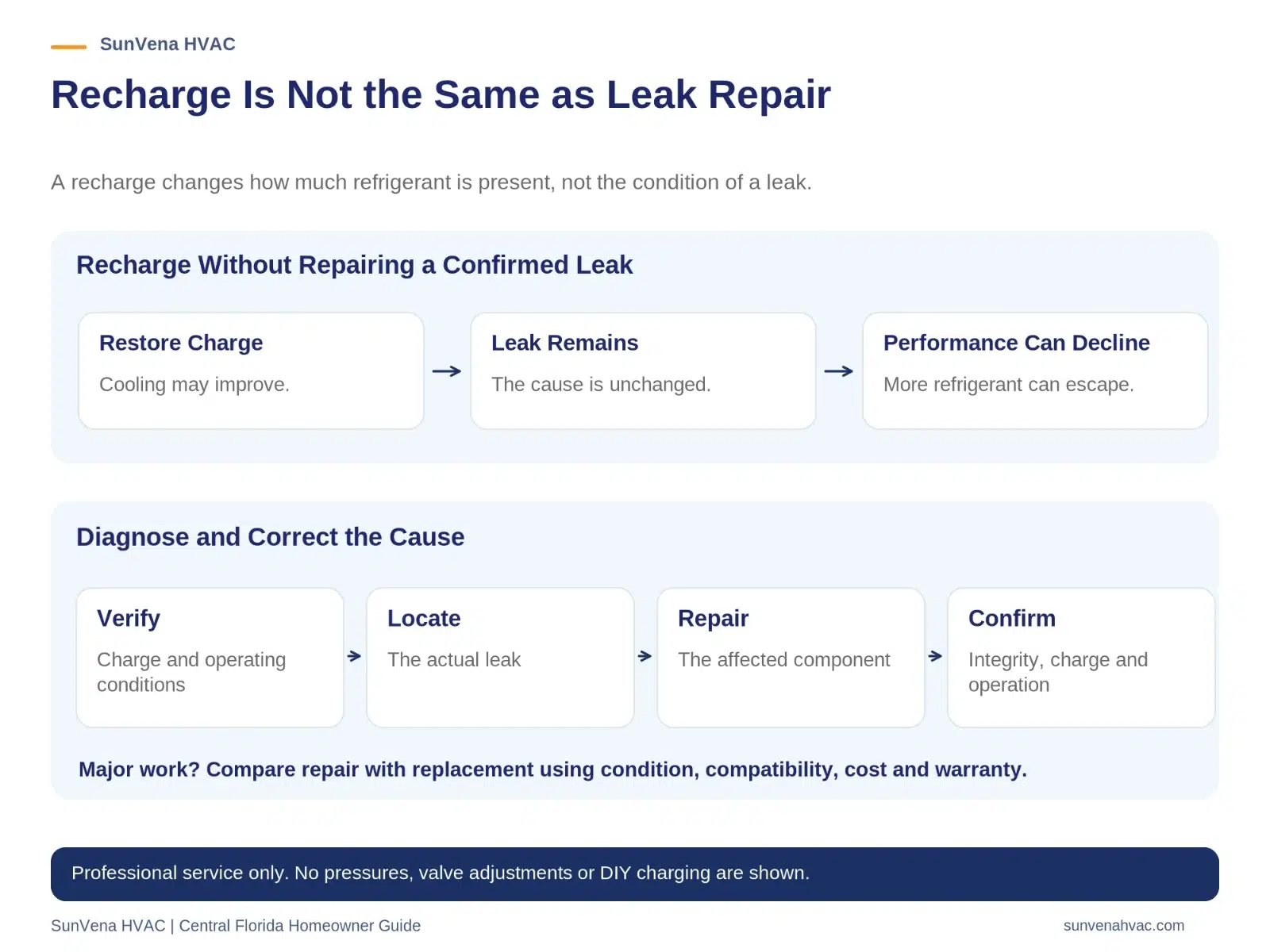
- Find the cause before repeatedly recharging: Adding refrigerant can restore operation temporarily, but it does not repair a leak. Leak location, system age, warranty coverage, and repair cost should drive the decision.
- R-410A can still be serviced in 2026: Existing R-410A systems remain legal to operate and repair, and compatible service components can continue to be manufactured and sold for legacy equipment.
- Do not assume R-410A prices rise on a fixed schedule: Federal HFC allowance caps step down again in 2029, which can affect long-term supply and pricing, but no rule guarantees a specific annual price increase.
- Refrigerant work is professional-only: EPA Section 608 certification is required for technicians who attach gauges, add or remove refrigerant, or otherwise open the refrigerant circuit on residential central AC equipment.
If a technician says your Central Florida air conditioner is low on refrigerant, the next question should be why. Refrigerant circulates through a closed refrigeration circuit and is not intentionally consumed during normal operation. If a system that was previously charged correctly is now low, leakage is the most likely explanation.
There is one important exception to the shorthand “low refrigerant means a leak.” A system can also be undercharged because it was not charged correctly during installation or prior service. That is why a proper diagnosis should confirm system charge and operating conditions rather than assuming every warm-air, frozen-coil, or low-pressure complaint is a refrigerant leak.
If a leak is confirmed, the decision becomes whether to repair the leak, replace the failed component, temporarily recharge the system, or replace the air conditioner. In 2026, that decision depends on the leak location, refrigerant type, equipment age, warranty coverage, repair history, and condition of the rest of the system.
Does Low Refrigerant Always Mean Your AC Has a Leak?
Not always, but an unexplained loss of charge from a previously correct system strongly points to leakage.
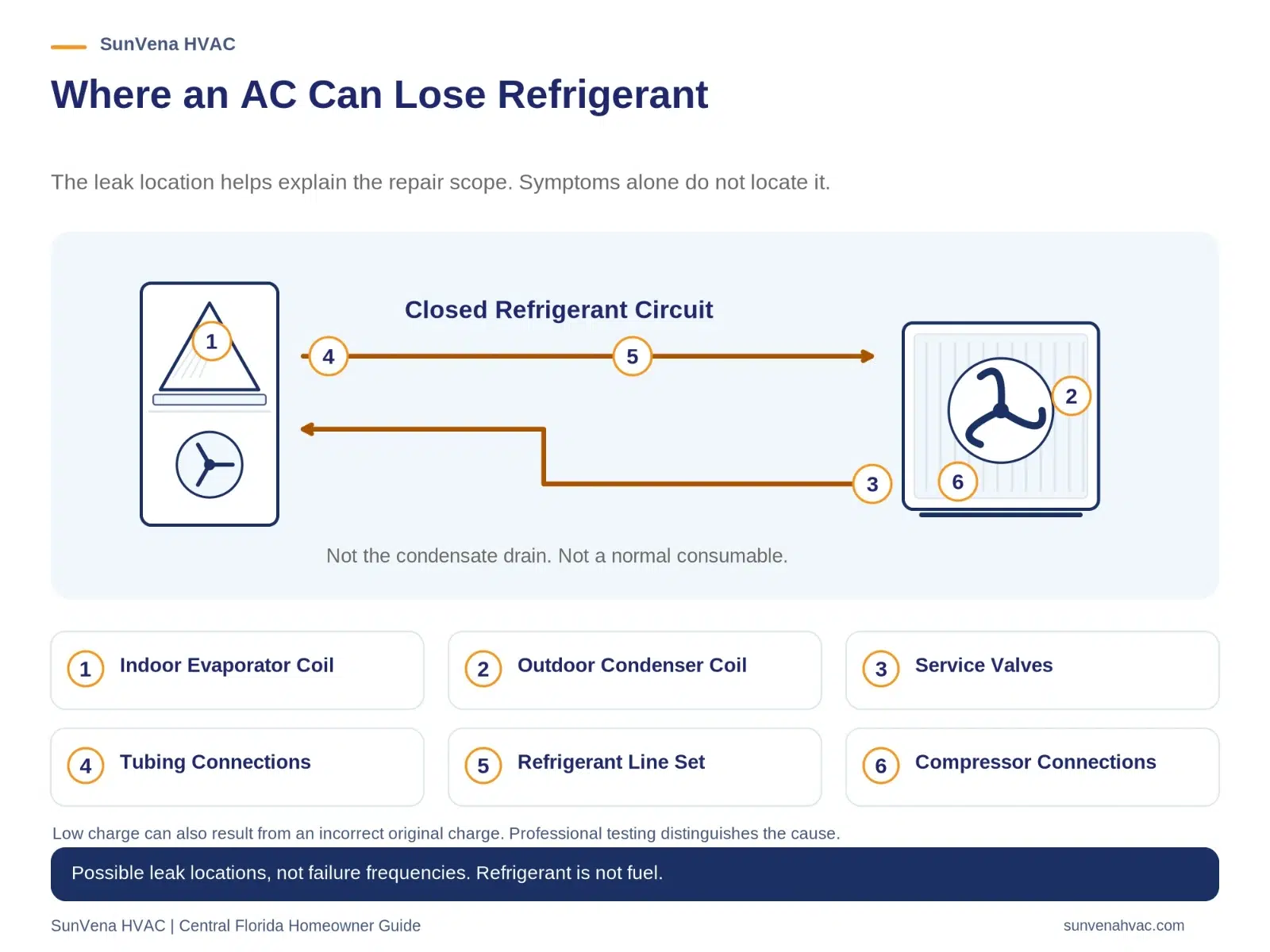
Air conditioners are designed to operate with a specified refrigerant charge. Refrigerant moves through the evaporator coil, compressor, condenser, and metering device in a closed circuit. It changes pressure and state as it absorbs and rejects heat, but the system does not intentionally burn or consume refrigerant.
A system can be undercharged for two broad reasons:
- Refrigerant escaped from the circuit. Leaks can develop at coils, tubing, joints, service valves, fittings, or other refrigerant-containing components.
- The correct charge was never established. Improper installation or previous service can leave a system undercharged even when there is no active leak.
The U.S. Department of Energy identifies improper refrigerant charging as an HVAC installation fault, and ENERGY STAR emphasizes that proper refrigerant charge and airflow are both critical to air-conditioner performance. That is why “low pressure” and “low refrigerant” should not be treated as interchangeable homeowner diagnoses.
What Are the Signs of Low Refrigerant or a Refrigerant Leak?
Possible clues include:
- Cooling capacity that has noticeably declined
- The AC running for long periods without reaching the thermostat setting
- Supply air that is warmer than expected
- Ice on the evaporator coil or larger insulated refrigerant line
- Indoor humidity that remains higher than normal while the AC runs
- Hissing or bubbling near a leaking refrigerant component in some cases
- A technician documenting an abnormal refrigerant charge after accounting for airflow and operating conditions
None of those symptoms proves a refrigerant leak by itself. Restricted airflow, a dirty evaporator coil, blower problems, duct issues, incorrect equipment operation, or other faults can create similar symptoms.
If you see ice, turn the thermostat from Cool to Off and allow the system to thaw rather than continuing to run the compressor. Our guide to ice on AC refrigerant lines in Central Florida explains the safe first steps and the major airflow and refrigerant-related causes.
Can a Technician Diagnose Low Refrigerant From Pressure Alone?
No. Refrigerant pressures are useful diagnostic measurements, but a pressure reading by itself does not prove that a system is undercharged or identify a leak.
Pressure changes with indoor and outdoor temperatures, airflow, equipment loading, metering-device operation, coil condition, and other system variables. A technician may need to evaluate several measurements and conditions together, including:
- Indoor and outdoor temperature
- Airflow across the evaporator coil
- Suction and liquid pressures
- Refrigerant saturation temperatures
- Superheat or subcooling, when applicable to the equipment
- Supply and return air temperatures
- Manufacturer charging specifications
- System history and previous service records
A refrigerant diagnosis should distinguish an actual charge problem from an airflow restriction, metering-device problem, dirty coil, or other condition that can distort pressures and temperatures.
Why Is Repeatedly Topping Off Refrigerant Usually a Poor Long-Term Fix?
Adding refrigerant can restore the correct charge for a period of time, but it does not close the leak. If refrigerant continues to escape, cooling performance can decline again and the homeowner pays repeatedly for refrigerant without correcting the underlying failure.
There are also environmental and equipment reasons to avoid treating repeated top-offs as a maintenance plan. R-410A is an HFC refrigerant with a high global warming potential, and EPA regulations prohibit intentional venting of HFC refrigerants during service. Operating with an incorrect charge can also reduce efficiency and place the refrigeration system outside its intended operating conditions.
That does not mean every residential recharge without an immediate leak repair is automatically illegal. EPA’s mandatory leak-repair provisions apply to specific covered appliances and charge sizes, while typical residential split systems are much smaller. What Section 608 does require is certified refrigerant handling and proper service practices. From a homeowner standpoint, the practical issue remains the same: a recharge changes the amount of refrigerant in the system, not the condition that allowed refrigerant to escape.
How Does an HVAC Technician Find an AC Refrigerant Leak?
A good leak search is designed to identify the actual leak location rather than simply confirm that system charge is low. The appropriate method depends on the size and location of the leak, equipment design, accessibility, and what earlier testing shows.
Common professional methods can include:
- Visual inspection: Oil residue, rubbed tubing, corrosion, damaged fittings, or other physical evidence can help identify suspicious areas.
- Electronic leak detection: An electronic refrigerant detector can identify refrigerant escaping around coils, joints, valves, and tubing.
- Bubble solution: A compatible leak-detection solution can provide visual confirmation at accessible joints or suspected leak points.
- Dry nitrogen pressure testing: After refrigerant is properly recovered when required, a technician may pressurize the circuit with dry nitrogen to evaluate leakage and help locate a fault.
- Ultrasonic or other specialized methods: Some leak situations call for additional tools or techniques.
- UV dye when appropriate: Manufacturer-approved dye may be useful for certain slow or difficult-to-locate leaks, depending on the equipment and service strategy.
EPA guidance distinguishes between measurements that indicate a system may be leaking and methods that actually locate the leak. Pressure checks and charging charts can help diagnose system operation, but they do not tell the technician where refrigerant is escaping.
Where Do Residential AC Refrigerant Leaks Occur?
| Possible Leak Location | What It Can Involve | Repair or Replacement Consideration |
|---|---|---|
| Service valve or valve core | A leaking seal, valve core, cap, or service connection | Often a localized repair if the rest of the system is healthy |
| Brazed joint or line-set connection | Installation joint failure, vibration, stress, or physical damage | Often repairable when the location is accessible and the tubing is otherwise sound |
| Refrigerant line set | Rub-through, impact damage, corrosion, or an inaccessible concealed leak | Depends heavily on accessibility and whether a section can be repaired or the line set must be replaced |
| Evaporator coil | Leak within the indoor coil or its tubing connections | Coil replacement can make sense on a younger or well-warrantied system; older systems should be compared with replacement |
| Condenser coil | Outdoor coil damage, corrosion, vibration, or tubing failure | Repairability depends on leak location, coil construction, warranty, and equipment age |
| Compressor or associated tubing | Leak at compressor connections, shell, tubing, or related components | Potentially a major repair, especially on older out-of-warranty equipment |
The leak location matters more than a generic diagnosis of “low refrigerant.” A repairable connection on an otherwise healthy system creates a very different decision from a leaking coil on older equipment with additional wear.
What Is Formicary Corrosion, and Does It Cause AC Coil Leaks?
Formicary corrosion is one recognized failure mechanism in copper heat-exchanger tubing. It creates microscopic tunnel-like corrosion in the copper and can eventually produce pinhole leaks. Manufacturers and industry literature have associated it with chemical reactions involving organic acids and contaminants around copper surfaces.
It should not be used as a catch-all explanation for every evaporator-coil leak. A technician still needs to locate the actual leak and determine the condition of the coil. Humidity or living in Florida alone does not prove that a coil failed from formicary corrosion.
When a coil has widespread or inaccessible leakage, replacing the coil may be more practical than attempting localized repairs. Whether the entire HVAC system should be replaced is a separate decision based on age, warranty, compatibility, repair cost, efficiency, and the condition of the remaining components.
Should You Repair a Refrigerant Leak or Replace the AC?
Repair generally deserves the stronger case when:
- The system is relatively young or in good overall condition
- The leak is localized and accessible
- The failed coil or component has meaningful warranty coverage
- The system has not developed repeated leaks
- Cooling, humidity control, and energy use were satisfactory before the failure
- Compatible repair parts are available
Replacement deserves a closer comparison when:
- The system is older and the leak involves an expensive major component
- There have been repeated refrigerant leaks or previous major repairs
- The coil, compressor, or multiple refrigerant-circuit components are deteriorating
- Warranty coverage has expired and the out-of-pocket repair is substantial
- The system already has comfort, airflow, humidity, noise, or efficiency problems
- A repair would put significant money into a system with other known issues
There is no universal age or repair amount that automatically decides the answer. SunVena’s AC repair or replacement guide for Central Florida explains how to compare system age, repair cost, warranty, refrigerant, comfort, and expected ownership horizon without relying on one rule of thumb.
Can an R-410A Air Conditioner Still Be Repaired in 2026?
Yes. Existing R-410A air conditioners and heat pumps can continue to operate and be repaired. EPA’s Technology Transitions program was designed to allow legacy systems to remain in service through their useful life.
EPA specifically allows homeowners to replace a failed R-410A component, including a condensing unit, indoor coil, compressor, or other compatible service component, with an R-410A component intended for servicing existing equipment. Those service components can continue to be manufactured and imported subject to the program’s requirements.
That means a leaking R-410A evaporator coil does not automatically require a complete R-454B or R-32 system replacement.
However, R-454B or R-32 components cannot simply be mixed into an R-410A system that was not designed for them. Refrigerants have different pressure, safety, lubricant, component, and design requirements. EPA notes that mildly flammable refrigerants such as R-454B and R-32 cannot be used in systems that were not designed for those refrigerants.
EPA also changed the installation rules in 2026. The agency removed the January 1, 2026 installation deadline for residential and light-commercial systems above the new 700 GWP limit when all specified components were manufactured domestically or imported before January 1, 2025. That allows remaining qualifying pre-2025 R-410A inventory to continue being installed while it remains available.
For the complete timeline, see SunVena’s 2026 R-410A phase-down guide for Florida homeowners.
Will R-410A Cost More Because of the HFC Phasedown?
R-410A servicing economics can change as the federal HFC phasedown continues, but homeowners should be cautious with claims that refrigerant prices will rise by a specific amount every year.
Under the American Innovation and Manufacturing Act, EPA caps the overall production and consumption of regulated HFCs. The current allowance level is 60 percent of baseline for 2024 through 2028. The cap drops to 30 percent of baseline for 2029 through 2033, 20 percent for 2034 through 2035, and 15 percent beginning in 2036.
Those are economy-wide HFC allowance caps, not an R-410A-specific production schedule. EPA has acknowledged that legacy HFC refrigerant prices may rise as the phasedown continues, but actual R-410A pricing also depends on inventories, demand, reclaimed refrigerant, distribution, and market conditions.
The accurate takeaway is that a leak-prone R-410A system carries more future refrigerant-cost uncertainty than a leak-free system. It is not accurate to promise that the price will increase every year or that a specific increase happens automatically in 2029.
What Should a Proper Refrigerant Leak Repair Include?
The exact procedure depends on the equipment and where the leak is located, but a professional repair should address both the leak and the correct system charge.
Depending on the repair, the technician may need to:
- Confirm the system problem. Verify that the apparent refrigerant issue is not primarily caused by airflow, controls, coils, or another fault.
- Locate the leak. Identify the specific component or connection allowing refrigerant to escape.
- Recover refrigerant when required for the repair. Refrigerant must be handled using EPA-compliant recovery and service practices.
- Repair or replace the leaking component. The correct method depends on whether the fault is in tubing, a fitting, a valve, a coil, a compressor connection, or another component.
- Verify the integrity of the repaired circuit. Pressure testing or another appropriate method may be used before returning the system to operation.
- Evacuate the opened circuit when required. A proper vacuum removes air and moisture before refrigerant is restored.
- Restore the refrigerant charge according to manufacturer specifications. The proper charging procedure may involve a weighed-in charge, line-set adjustment, and verification using superheat, subcooling, or other manufacturer-specified methods depending on the equipment.
- Confirm normal operation. Airflow, temperatures, pressures, controls, and other operating data should make sense together after the repair.
“Recharge it to factory weight” is not a universal description of the entire charging process for every field-installed split system. Factory charge often assumes a specified line-set length, and final verification methods depend on the system design and manufacturer instructions.
Can You Recharge a Central AC Yourself?
No. Residential central-air refrigerant service is not a homeowner DIY task.
EPA Section 608 requires technician certification for activities that can release refrigerant, including attaching or disconnecting gauges, adding refrigerant, removing refrigerant, and opening the refrigerant circuit.
Automotive recharge cans are also not substitutes for residential HVAC refrigerant. Vehicle AC systems fall under different service rules and use equipment and refrigerants specific to automotive applications. Do not connect an automotive recharge product, unapproved refrigerant, or improvised charging equipment to a home air conditioner.
How Can You Catch Refrigerant Problems Earlier?
Routine HVAC maintenance can help identify performance problems before they become a no-cooling call, but maintenance should not be described as a guarantee that every slow leak will be found before refrigerant loss becomes noticeable.
ENERGY STAR’s HVAC maintenance checklist recommends checking central air-conditioner refrigerant level and correcting it if necessary. A technician should interpret refrigerant measurements together with airflow and manufacturer specifications.
Homeowners can also watch for changes between maintenance visits:
- Longer cooling times than the home normally requires under similar weather
- New ice on refrigerant tubing or the indoor coil area
- Cooling that improves after a recharge and then declines again
- Repeated service calls for low charge
- Unusual hissing near refrigerant components
- Indoor humidity or comfort that has noticeably worsened
Those observations are useful diagnostic history. They are not a substitute for a leak test.
Learn more about AC maintenance in Greater Orlando and what should be inspected during a cooling-system service visit.
Frequently Asked Questions
Does AC refrigerant need to be refilled every year?
No. A properly installed and correctly charged air conditioner should not require an annual refrigerant refill as routine maintenance. If a system that previously had the correct charge repeatedly needs refrigerant added, ask why the charge is being lost and whether a leak search is appropriate.
Can low airflow look like low refrigerant?
Yes. Restricted airflow can reduce evaporator temperature and change refrigerant pressures, sometimes producing symptoms that resemble an undercharged system. A dirty filter, blower problem, dirty coil, duct restriction, or other airflow issue should be considered before diagnosing charge from pressure alone.
Is topping off a leaking residential AC illegal?
Not automatically. EPA requires certified handling of refrigerant and prohibits intentional venting during HVAC service. Separate federal mandatory leak-repair requirements apply to specified covered appliances and charge sizes and generally do not make a typical residential split-system top-off automatically illegal. Even when adding refrigerant is legally permissible, it does not repair the underlying leak.
Is R-410A banned in 2026?
No. Existing R-410A systems remain legal to use, maintain, and repair. Compatible R-410A components can continue to be sold for servicing legacy systems. Federal rules are reducing the use of high-GWP refrigerants in new equipment while allowing existing systems to remain in service.
Will R-410A disappear in 2029?
No. The overall federal HFC allowance cap drops from 60 percent of baseline to 30 percent in 2029, but that is not an R-410A ban or an R-410A-specific production quota. R-410A can continue to be used to service existing systems, including through available virgin and reclaimed supply.
Can you repair a leaking evaporator coil?
Sometimes a localized accessible leak can technically be repaired, but coil construction, leak location, corrosion, warranty requirements, manufacturer guidance, and the likelihood of additional leaks all matter. In many cases, replacing a failed evaporator coil provides a more durable repair than patching compromised tubing.
Should I replace an older R-410A AC if the evaporator coil leaks?
Not automatically. Compare the all-in coil repair or replacement cost with the age and condition of the outdoor unit, compressor, motors, controls, warranty coverage, repair history, efficiency, and a properly sized replacement proposal. A younger warrantied system may strongly favor coil replacement, while an older system with multiple problems may justify full replacement.
AC Refrigerant Leak Diagnosis and Repair in Central Florida
If your AC is low on refrigerant, freezing, or losing cooling capacity, SunVena HVAC can diagnose the system before recommending a recharge, leak repair, component replacement, or new system. SunVena provides AC repair in Greater Orlando and Volusia County for R-410A and current-generation residential cooling systems.
If the leak involves an older system and replacement is worth comparing, review SunVena’s AC installation and replacement services. To have the problem evaluated, schedule HVAC service online or call (321) 621-5156.
Safety note: Do not attach gauges, add refrigerant, open service valves, bypass refrigeration controls, use automotive recharge kits, or attempt to braze refrigerant tubing. Refrigerant-circuit service requires trained, EPA-certified technicians and appropriate recovery and service equipment.