📌 Key Points
- Use humidity as a measured number: EPA recommends keeping indoor relative humidity below 60 percent and ideally between 30 and 50 percent. Recent UF/IFAS Central Florida guidance says around 55 percent or lower is a practical goal for Florida homes.
- There is no magic mold threshold: Mold needs moisture, but 60 percent RH is a prevention guideline, not a switch. Condensation, leaks, wet materials, and damp surfaces can create local mold conditions even when the room average looks acceptable.
- Your AC is a major dehumidifier: A properly sized and maintained cooling system removes moisture as air passes over the cold evaporator coil. Sizing, airflow, runtime, duct leakage, and controls all affect how well it performs that job.
- Fan Auto is usually the better cooling-season default: Continuous blower operation can re-evaporate moisture from a wet coil after the compressor stops. Equipment with specialized ventilation or dehumidification controls may use different logic.
- Do not shut cooling off for a long summer absence: Seasonal Central Florida homes still need moisture control. Use an appropriate temperature and humidity strategy, remote monitoring, and a reliable condensate system rather than leaving the home unconditioned.
- Persistent humidity deserves diagnosis before gadgets: Check water sources, airflow, ducts, sizing, thermostat operation, condensate drainage, and HVAC performance. Whole-home dehumidification can be valuable when those basics are sound and humidity still stays high.
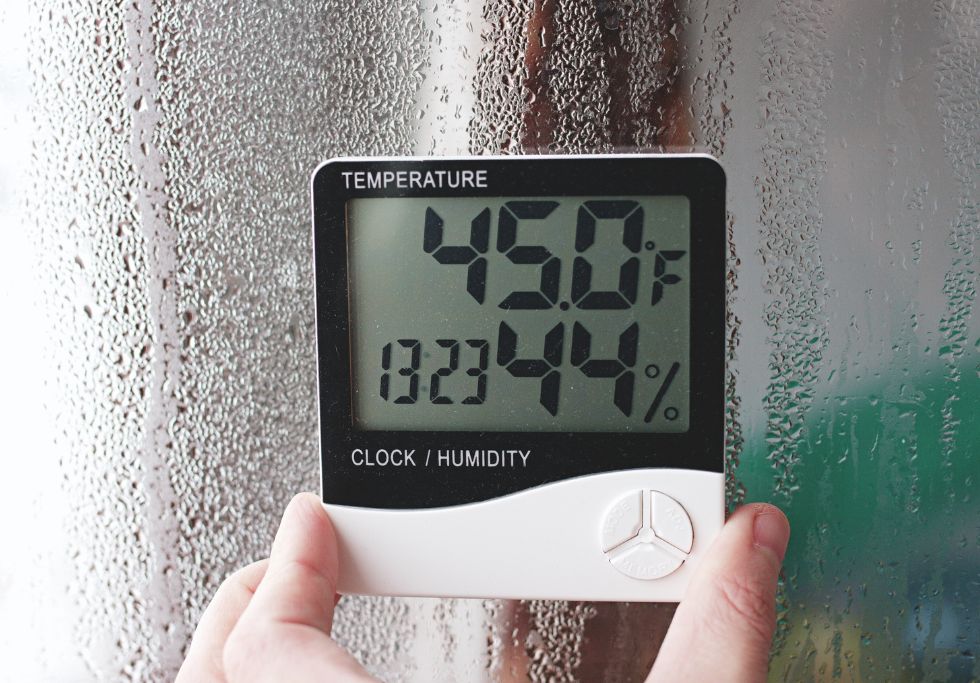
For most Central Florida homes, indoor humidity should stay below 60 percent, with roughly 30 to 50 percent relative humidity being EPA’s ideal range when practical. Recent 2026 guidance from UF/IFAS Extension’s Central District gives Florida homeowners a useful local benchmark as well: aim for indoor humidity around 55 percent or lower and monitor it with a hygrometer or thermostat humidity sensor.
The important nuance is that 60 percent is not a magic line where mold suddenly begins. Mold growth depends on moisture at the surface, how long materials stay damp, temperature, air movement, and the material itself. A room can average below 60 percent while a cold supply register, exterior wall, closet, or area around a leak stays wet enough to support growth.
In Central Florida, humidity control is therefore a whole-home moisture problem, not just a thermostat setting. Your air conditioner is one of the primary tools for removing moisture, but drainage, duct leakage, outdoor-air infiltration, showers, cooking, wet materials, equipment sizing, and ventilation can all change the result.
What Indoor Humidity Level Is Best in Central Florida?
Two current, authoritative benchmarks are useful:
- EPA: Keep indoor relative humidity below 60 percent if possible, ideally between 30 and 50 percent.
- UF/IFAS Central Florida guidance: Indoor relative humidity should generally remain around 55 percent or lower.
Those recommendations overlap rather than conflict. A practical way to interpret them is:
| Indoor Relative Humidity | How to Think About It | What to Do |
|---|---|---|
| 30 to 50 percent | EPA’s ideal range when practical | Maintain normal HVAC operation and continue monitoring |
| About 50 to 55 percent | Commonly workable in humid climates and consistent with recent UF/IFAS guidance of around 55 percent or lower | Watch for condensation, musty odors, room-to-room differences, and upward trends |
| Sustained above 60 percent | Above EPA’s recommended limit and worth investigating | Look for moisture sources, HVAC or airflow problems, infiltration, duct leakage, and dehumidification needs |
| Sudden spike after a leak or flood | May reflect wet building materials rather than normal seasonal humidity | Stop the water source and dry affected materials promptly |
EPA’s mold and moisture guidance recommends drying wet or damp materials within 24 to 48 hours when possible and keeping AC drip pans clean with drain lines unobstructed. A recent UF/IFAS Central Florida housing guide similarly emphasizes HVAC maintenance, condensate drainage, exhaust fans, air sealing, and indoor humidity monitoring.
How Should You Measure Humidity in Your Home?
A hygrometer measures relative humidity and is inexpensive enough that it is often better to measure than to guess based on whether the house feels sticky.
For useful readings:
- Place the sensor in a representative living area rather than directly beside a supply register
- Avoid direct sunlight, exterior doors, bathrooms, kitchens, and other locations with short-term moisture or temperature swings unless that location is specifically what you are investigating
- Keep comparison sensors at roughly similar heights
- Compare the main living area with a bedroom, closet, bonus room, or other area that feels different
- Watch the trend through the day instead of reacting to one reading
- Compare a portable hygrometer with the thermostat humidity reading if your thermostat reports RH
Relative humidity changes with temperature. That means a humidity percentage should always be interpreted alongside indoor temperature and the location of the sensor.
EPA notes that basic humidity meters are widely available and inexpensive. Two modest sensors in different parts of the house can be more useful than assuming one hallway thermostat represents every room.
Does 60 Percent Humidity Automatically Cause Mold?
No. EPA’s below-60-percent recommendation is a moisture-control guideline, not a biological on/off switch.
Mold spores are naturally present indoors and outdoors. EPA explains that there is no practical way to eliminate all mold spores from an indoor environment. The prevention strategy is to control moisture so spores do not find damp conditions that support growth.
Moisture can come from:
- High indoor relative humidity
- Plumbing or roof leaks
- Condensation on cold surfaces
- Flooding or storm intrusion
- Wet drywall, carpet, insulation, or furnishings
- Air-conditioner drainage problems
- Uncontrolled humid outdoor-air infiltration
A home averaging 52 percent RH can still have a mold problem behind a leaking wall. Conversely, one brief reading slightly above 60 percent does not prove mold is growing throughout the house.
Look for moisture sources and duration, not just one humidity number.
Where Does Indoor Moisture Come From in Central Florida?
Central Florida homes receive moisture from both indoor activities and outdoor air.
Outdoor Air Infiltration
Humid outdoor air can enter around doors, windows, penetrations, recessed fixtures, attic openings, and other gaps in the building envelope. Air leakage becomes especially important when pressure imbalances or duct leakage pull air from attics, garages, or outdoors.
Duct Leakage
Return-side duct leaks can draw hot, humid air from unconditioned spaces into the HVAC system. Supply leaks can also change building pressure and waste conditioned air. NIST research has linked duct leakage in hot, humid climates with increased indoor relative humidity and energy use.
Showers and Cooking
Bathing, cooking, dishwashing, and other daily activities release water vapor indoors. EPA recommends exhausting moisture-generating activities to the outdoors where appropriate.
Clothes Dryers
A dryer should vent outdoors. A disconnected or leaking dryer exhaust can release substantial heat and moisture into the house or an adjacent space.
Water Leaks and Wet Materials
Roof leaks, plumbing leaks, storm damage, appliance leaks, and AC condensate problems can overwhelm normal HVAC dehumidification. EPA recommends drying wet materials quickly, ideally within 24 to 48 hours.
People, Plants, and Other Indoor Sources
Occupants, pets, aquariums, indoor plants, and activities such as drying clothing indoors all contribute moisture. These loads are usually manageable in a healthy home but can become more important when combined with HVAC or building-envelope problems.
How Does Your Air Conditioner Remove Humidity?
Your central air conditioner cools and dehumidifies during the same process. Warm indoor air moves across a cold evaporator coil. When the coil surface is below the air’s dew point, water vapor condenses on the coil and drains into the condensate pan and drain system.
A July 2026 UF/IFAS Extension webinar recap describes the air conditioner as a dehumidifier for Florida homes and lists regular maintenance and clean condensate drain lines among the main ways to control indoor humidity.
How much moisture the system removes depends on more than whether the compressor is running. Important factors include:
- Equipment sizing
- Cooling-cycle length
- Indoor blower airflow
- Evaporator-coil design and temperature
- Thermostat and humidity-control logic
- Refrigerant-system performance
- Duct leakage
- Outdoor-air infiltration
- Condensate drainage
SunVena’s guide to how HVAC systems control cooling and humidity explains sensible and latent cooling in more detail.
Can an Oversized AC Make a Central Florida Home Humid?
Yes. Oversizing is one possible cause of poor humidity control.
An oversized conventional air conditioner can lower the thermostat temperature quickly and shut off before the cooling cycle has provided enough sustained moisture removal. The result can be a home that reaches setpoint but still feels damp.
That does not mean every humid house has an oversized AC. High humidity can also result from:
- Duct leakage
- Incorrect airflow
- Air infiltration
- Ventilation problems
- Refrigerant or coil performance problems
- Thermostat configuration
- Water intrusion
- Excess indoor moisture loads
If equipment replacement is being considered, use a residential load calculation rather than increasing or copying the old tonnage. SunVena’s Central Florida AC sizing and Manual J guide explains why sizing matters for both temperature and latent moisture control.
Should the Thermostat Fan Be Set to Auto or On in Central Florida?
Auto is a good cooling-season default for many Central Florida systems.
When the thermostat fan is set to On, the indoor blower may continue moving air after the compressor shuts off. Moisture still sitting on the evaporator coil can then evaporate back into the airstream instead of draining away.
Trane’s thermostat guidance notes that some Trane thermostats will not run the fan in On mode between cooling cycles when indoor humidity is above the setpoint.
The underlying mechanism is also documented in HVAC engineering literature: when the compressor stops, some condensate remaining on the coil can re-evaporate while airflow continues.
There are exceptions. Some variable-capacity, ventilation, filtration, or dedicated dehumidification systems intentionally control blower operation differently. If your HVAC system has equipment-specific humidity or ventilation logic, follow the manufacturer’s control strategy.
Should You Turn the AC Off When You Leave Home?
For a short absence, use a reasonable thermostat setback if appropriate for your equipment and household. For a long Central Florida summer absence, do not simply shut off all cooling and moisture control.
A sealed, unoccupied home can still receive moisture through air leakage, building materials, plumbing problems, and normal environmental conditions. Without cooling or dedicated dehumidification, indoor humidity can rise even though nobody is there.
UF/IFAS seasonal-home guidance recommends leaving central air conditioning in operation and managing the home with a thermostat, humidistat, or dehumidifier rather than shutting the system off. The exact temperature setting should be tailored to the home, equipment, humidity controls, and monitoring strategy.
How Should Snowbirds Manage Humidity in a Central Florida Home?
Seasonal residents should manage humidity as a monitored system rather than relying on one thermostat number for months at a time.
Before leaving:
- Have the HVAC system serviced if it is due
- Confirm the condensate drain is flowing properly
- Check the filter
- Verify thermostat and humidity readings
- Test any humidistat or dehumidification controls
- Use remote temperature and humidity monitoring when practical
- Arrange for someone local to check the property periodically
- Repair plumbing, roof, door, or window leaks before departure
- Make sure bathroom and dryer exhaust systems terminate properly outdoors
If the home uses a whole-home dehumidifier, confirm that its drain and control system are operating before departure. If you rely on the central AC for humidity control, choose a temperature and humidity strategy appropriate for your equipment rather than turning it completely off.
UF/IFAS seasonal-home guidance also recommends having a trusted local person routinely check an unattended Florida property.
Does the AC Drain Line Affect Indoor Humidity?
The condensate system does not determine how much moisture the evaporator coil can condense, but it has to safely remove the water the coil collects.
If drainage backs up, several things can happen:
- An overflow safety may shut cooling down
- Water may collect in or around the air handler
- Wet materials can create a separate moisture problem
- Cooling and dehumidification stop if the system shuts down
EPA recommends keeping AC drip pans clean and drain lines unobstructed and flowing properly.
There is no universal monthly vinegar schedule that applies to every HVAC drain. Drain design, manufacturer guidance, access, materials, and maintenance history differ. Follow the installation and service recommendations for the specific system.
If water is already present around the unit, see SunVena’s guide to an AC leaking water in Central Florida.
Can Duct Leaks Make Your House More Humid?
Yes. Duct leakage can affect humidity as well as cooling efficiency.
If return ductwork located in a hot attic leaks, the blower can draw unconditioned attic air into the HVAC system. Supply leakage can waste conditioned air and alter the pressure relationship between indoors and outdoors, which can contribute to additional infiltration.
NIST research found that leaky ducts in hot, humid climates can increase indoor relative humidity as well as energy use.
Duct problems are more likely when high humidity is accompanied by:
- Hot or uneven rooms
- Weak airflow
- Visible disconnected or damaged ducts
- High cooling bills
- Dust intrusion
- Humidity changes when bedroom doors are closed
Humidity alone does not prove that ducts leak. Airflow and duct conditions should be measured or inspected before recommending sealing or replacement.
Do Variable-Capacity AC Systems Control Humidity Better?
They can provide better humidity-control potential because they can often run for longer periods at lower cooling output instead of repeatedly cycling between full output and off.
Many manufacturers now offer inverter-driven, variable-capacity systems that can run at lower speeds for longer periods, which can improve humidity consistency in hot, humid climates.
But variable capacity is not a universal cure. Actual humidity control still depends on:
- Correct sizing
- Minimum compressor capacity
- Indoor blower setup
- Controls
- Ductwork
- Building air leakage
- Moisture load
- Installation quality
A correctly sized single-stage system can control humidity well in many homes, while a poorly sized or configured premium system can still disappoint.
When Is a Whole-Home Dehumidifier Worth It?
A whole-home dehumidifier becomes worth considering when excessive humidity persists after water leaks, HVAC faults, airflow problems, duct problems, and obvious building-envelope issues have been addressed.
ENERGY STAR says a properly sized whole-home dehumidifier may be a good choice in a humid climate for relatively well-sealed homes with central air conditioning that consistently experience humidity above about 55 percent throughout the house.
That is especially relevant when:
- The home has low sensible cooling demand but high moisture load
- Indoor RH remains elevated during mild but humid weather
- The home is tightly built and the AC does not need to run long enough to meet the latent load
- A seasonal home needs humidity control independent of cooling demand
- Humidity remains consistently high after HVAC and building problems have been corrected
Whole-home units can be ducted to serve multiple rooms and drain automatically. They should be sized and integrated properly rather than selected only from square footage.
SunVena’s Central Florida indoor air quality services include whole-home dehumidification and related moisture-control options.
What About a Portable Dehumidifier?
A portable dehumidifier can be useful for one room or localized damp area. ENERGY STAR distinguishes portable room dehumidifiers from ducted whole-home systems and notes that portable units are typically intended for a single space.
Portable dehumidifiers:
- Can provide meaningful moisture removal in a targeted room
- Add some heat to the space while operating
- Need a bucket emptied or a suitable continuous drain
- Do not fix a roof leak, plumbing leak, duct problem, or malfunctioning AC
- May not represent the most efficient solution when the entire home has elevated RH
Small disposable moisture-absorbing products can help in closets or very small enclosed spaces, but they are not substitutes for mechanical whole-home humidity control.
What Should You Do If You Find Mold?
First, identify and correct the moisture source. Cleaning mold without controlling the water or humidity that supported it makes recurrence likely.
EPA says moldy areas smaller than about 10 square feet can often be handled by homeowners using appropriate mold-cleanup guidance. Larger areas, extensive water damage, hidden contamination, or complex materials may justify professional remediation.
There is an important HVAC exception: if you know or suspect that the HVAC system itself is contaminated with mold, EPA recommends not operating the system until the contamination has been evaluated or remediated because operation can spread material through the building.
An HVAC contractor can diagnose moisture, condensate, airflow, duct, or equipment problems associated with the system. Mold remediation itself may require a separate qualified remediation professional depending on the scope.
What Is the Best Order for Fixing High Humidity in Central Florida?
- Measure it. Confirm the RH pattern with a reliable hygrometer or thermostat sensor.
- Look for water first. Check for plumbing leaks, roof leaks, condensate problems, storm intrusion, and wet materials.
- Use exhaust correctly. Run bathroom and kitchen exhaust fans as appropriate and verify that dryers vent outdoors.
- Use the thermostat and fan appropriately. Avoid long summer shutdowns and use Auto as the cooling-season fan default unless the equipment calls for another strategy.
- Check HVAC maintenance basics. Filter, coils, drainage, controls, and system operation all matter.
- Evaluate airflow and ducts, especially when humidity comes with hot rooms, weak airflow, high bills, or attic duct concerns.
- Check equipment sizing and performance. Oversizing, incorrect airflow, or refrigeration faults can reduce latent performance.
- Address air leakage and ventilation problems. Do not simply add a dehumidifier while large uncontrolled moisture sources remain.
- Consider equipment-level humidity solutions. Variable-capacity controls or whole-home dehumidification can make sense after the underlying system is sound.
Frequently Asked Questions
What humidity level should my Central Florida home be?
EPA recommends below 60 percent and ideally 30 to 50 percent when practical. UF/IFAS Central Florida guidance published in 2026 recommends generally keeping indoor RH around 55 percent or lower. Sustained readings above 60 percent deserve investigation, especially if you also see condensation, water damage, or musty conditions.
Is 55 percent humidity too high indoors?
Not necessarily. EPA’s ideal range is 30 to 50 percent, while recent UF/IFAS guidance for Florida homes says around 55 percent or lower is generally appropriate. A consistent 55 percent reading without condensation or moisture problems is different from a house climbing into the 60s and 70s.
Will 60 percent humidity cause mold?
Not automatically. Mold growth depends on moisture at surfaces, duration, temperature, materials, and other conditions. EPA uses below 60 percent as a prevention target because higher indoor humidity increases moisture risk. Leaks and condensation can support mold even when average room RH is below 60 percent.
Should I leave my AC fan on Auto or On for humidity control?
Auto is a good cooling-season default for many Central Florida homes because continuous fan operation after the compressor stops can re-evaporate moisture remaining on the evaporator coil. Follow manufacturer guidance if your system has specialized ventilation, filtration, or dehumidification controls.
What thermostat setting prevents mold when I leave Central Florida for the summer?
There is no universal thermostat number that guarantees mold prevention. Keep active cooling or dedicated dehumidification in operation, monitor indoor RH, and aim to keep it below 60 percent. The best temperature and humidity settings depend on the home, thermostat, HVAC system, building envelope, and whether separate dehumidification is available.
Can lowering the thermostat fix high humidity?
It may increase cooling runtime and temporarily remove more moisture, but it is not a good substitute for diagnosing why humidity is high. A home that needs to be overcooled to stay dry may have sizing, airflow, duct, infiltration, control, or moisture-source problems.
Do I need a whole-home dehumidifier in Central Florida?
Not every home does. ENERGY STAR says whole-home dehumidification may be appropriate in humid climates when a relatively well-sealed home with central AC consistently remains above about 55 percent RH. Diagnose leaks, HVAC performance, airflow, ducts, and building moisture sources before adding equipment.
Can my AC drain line cause mold?
A blocked drain can create standing water, leaks, wet building materials, or a safety shutdown that stops cooling and dehumidification. Those moisture conditions can contribute to mold risk. Keep the condensate system unobstructed and correct leaks promptly.
Is a small mold patch something I can clean myself?
EPA says areas smaller than about 10 square feet can often be handled by homeowners following its cleanup guidance. Larger contamination, extensive water damage, hidden growth, or suspected HVAC-system contamination can require professional evaluation. Always correct the moisture source as part of the cleanup.
Humidity Control and Dehumidification in Central Florida
SunVena HVAC helps Central Florida homeowners diagnose high indoor humidity, condensate problems, airflow and duct issues, cooling-system performance, and whole-home dehumidification needs.
Homeowners can review local HVAC and indoor-comfort service information for Orlando and Sanford, or explore SunVena’s complete Central Florida HVAC service area across Greater Orlando and Volusia County.
For system-level humidity and air-quality options, visit SunVena’s indoor air quality services. If your AC is due for service, review AC maintenance. To have a persistent humidity problem evaluated, schedule HVAC service online or call (321) 621-5156.
Safety note: Do not open energized HVAC compartments, handle refrigerant, bypass float switches or refrigerant sensors, enter unsafe attic spaces, or disturb suspected mold inside HVAC equipment. If electrical equipment is wet or the HVAC system itself may be contaminated with mold, leave it off and obtain appropriate professional guidance.