📌 Key Points
- More than cooling: A Florida HVAC system also removes moisture, moves air to each room, filters it, and drains condensate.
- Two kinds of heat: Sensible heat raises the temperature; latent heat is carried by water vapor and removed at the indoor coil.
- Humidity target: EPA recommends keeping indoor humidity below 60 percent, ideally between 30 and 50 percent.
- Ducts matter: ENERGY STAR estimates a typical house loses 20 to 30 percent of the air moving through its ducts.
- Right-sized equipment: An oversized system can short cycle and leave a home cool but damp.
- R-410A systems: Existing systems can still be repaired, though some components may become harder to find.
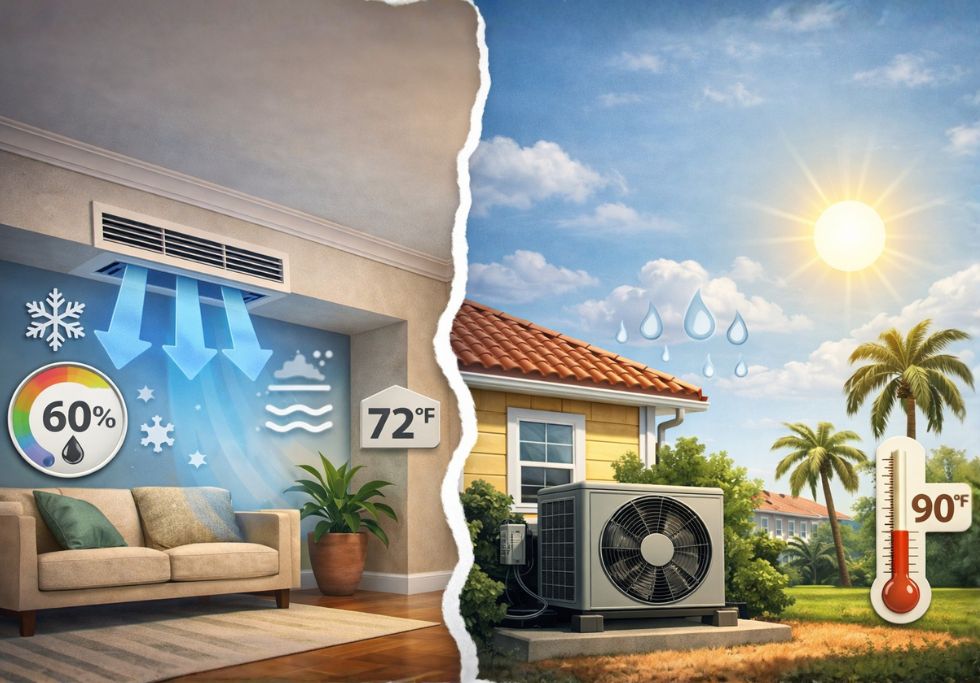
Your HVAC system does much more than lower the temperature. In a Central Florida home, it also has to remove moisture, move the right amount of air to each room, filter recirculated air, drain the water created during dehumidification, and reject indoor heat outdoors through a refrigeration cycle.
Understanding those jobs makes HVAC problems easier to recognize. A home that feels warm may have a cooling problem, an airflow problem, or both. A home that reaches the thermostat setting but still feels sticky may have a humidity-control problem. Water near the air handler points toward condensate drainage, a frozen coil, or another moisture issue rather than simply “the AC leaking.”
Knowing the difference can help homeowners ask better questions and make more informed decisions about AC repair, preventive maintenance, and AC replacement and installation.
Why HVAC Performance Is Different in Central Florida
Central Florida has an extended cooling season, high outdoor humidity, intense summer solar gain, frequent thunderstorms, and many homes with ductwork located in hot, unconditioned attic spaces. Coastal parts of Volusia County add another concern: salt-laden air can accelerate corrosion of outdoor HVAC equipment.
That means good HVAC performance here depends on more than raw cooling capacity. A well-designed system has to manage several loads at once:
- Sensible heat: The heat that raises indoor air temperature.
- Latent heat: The heat carried by water vapor in the air, which the system removes by condensing moisture on the indoor coil.
- Solar gain: Heat entering through windows, roofs, walls, and doors.
- Air leakage: Hot, humid outdoor air entering through gaps in the building envelope.
- Duct losses: Conditioned air lost through leaks or temperature gain in ducts outside the conditioned space.
- Internal loads: Heat and moisture from people, cooking, appliances, showers, lighting, and electronics.
This is why two Central Florida homes with the same square footage can need different HVAC capacities and behave very differently during summer. Equipment selection should reflect the actual home, not just its floor area.
How Does a Central Air Conditioner Actually Work?
A central air conditioner does not create “cold.” It moves heat from inside the home to the outdoors while circulating and dehumidifying indoor air.
The process can be simplified into six connected steps:
- The thermostat calls for cooling. Controls signal the indoor and outdoor equipment to operate according to the system’s design and staging.
- Return air comes back to the air handler. Indoor air moves through return grilles and ductwork, passes through the filter, and reaches the blower and evaporator coil.
- The evaporator coil absorbs indoor heat. Refrigerant inside the cold coil absorbs heat from the air. Moisture can also condense on the coil and drain away.
- The compressor moves refrigerant through the circuit. The outdoor compressor raises refrigerant pressure and keeps the refrigeration cycle moving.
- The condenser rejects heat outdoors. The outdoor fan moves air across the condenser coil so heat collected inside the home can be released outside.
- Supply ducts deliver conditioned air to the rooms. The blower pushes cooled, dehumidified air through the supply duct system while return pathways bring room air back to the equipment.
If any one of those pieces is restricted, incorrectly sized, leaking, dirty, misconfigured, or failing, the entire system can lose comfort or efficiency.
What Does the Thermostat Actually Control?
The thermostat is the primary control interface between the homeowner and the HVAC system. At its simplest, it measures temperature and tells the system when cooling or heating is needed.
Modern systems may also use the thermostat or a communicating controller to manage:
- Single-stage, two-stage, or variable-capacity operation
- Indoor blower speed
- Humidity targets
- Equipment protection delays
- Zoning
- Auxiliary heat on heat pumps
- Remote room sensors
- Ventilation or dehumidification equipment
- System alerts and diagnostics
A thermostat can change when and how equipment operates, but it cannot repair poor airflow, undersized returns, duct leaks, low refrigerant charge, dirty coils, or incorrect equipment sizing.
What Does SEER2 Tell You About an Air Conditioner?
SEER2 is a seasonal cooling-efficiency rating used for central air conditioners and heat pumps. It estimates cooling output relative to electrical energy consumption under a standardized laboratory test procedure.
SEER2 replaced the older SEER metric for new federal efficiency standards in 2023. AHRI explains that the newer Appendix M1 test procedure uses substantially higher external static pressure than the previous test, making the ducted-equipment test more representative of field conditions.
Florida is part of the federal Southeast region for split-system central air conditioners. Under the current standards, split-system AC installations generally must meet at least:
- 14.3 SEER2 when certified cooling capacity is below 45,000 Btu/h
- 13.8 SEER2 when certified cooling capacity is 45,000 Btu/h or greater
Heat pumps use a national efficiency standard rather than the Southeast AC regional standard.
A higher SEER2 rating can reduce cooling energy use compared with a lower-rated system under comparable conditions, but SEER2 is not a quality score and does not tell you whether the system is correctly sized, installed, charged, or connected to good ductwork.
There is also no universal rule that every Central Florida homeowner should buy 16 SEER2 or higher. Compare the actual AHRI-rated equipment combination, installed price, expected runtime, comfort features, warranty, staging, and ownership horizon. SunVena’s SEER and SEER2 guide for Central Florida homeowners goes deeper into that decision.
What Happens at the Return Air and Filter?
Before conditioned air can be delivered to your rooms, air from those rooms has to make its way back to the HVAC equipment.
Return grilles and return ducts provide that path. The filter is normally located somewhere in this return-air stream so airborne particles are captured before air reaches sensitive equipment surfaces such as the evaporator coil and blower.
A filter has two jobs:
- Help protect HVAC equipment from dust and debris
- Reduce some airborne particles recirculated through the system, depending on the filter’s efficiency and the amount of air actually passing through it
A more restrictive filter is not automatically better. If the filter creates excessive pressure drop for the equipment and duct system, airflow can fall. ENERGY STAR identifies proper airflow as a core requirement for HVAC performance because poor airflow can reduce efficiency, increase utility costs, worsen comfort, and contribute to damp indoor conditions.
If indoor air quality is a priority, filtration should be evaluated together with airflow, humidity, ventilation, source control, and the home’s specific concerns. SunVena’s Central Florida indoor air quality services cover filtration, dehumidification, air purification, and related options.
What Do the Air Handler and Evaporator Coil Do?
The air handler contains the indoor blower and, in many Central Florida systems, the evaporator coil. Some homes have the air handler in a garage, closet, mechanical room, or attic.
During cooling, warm return air moves across the cold evaporator coil. Two things happen at the same time:
- Heat transfers from the air into the refrigerant. The supply air leaving the coil becomes cooler.
- Water vapor condenses on the cold coil. The condensate falls into a drain pan and leaves through the drain system.
This is why an air conditioner is also an important dehumidification system. Coil temperature, airflow, runtime, equipment capacity, refrigerant performance, controls, and the home’s moisture load all affect how much water the system removes.
Where Does All That Water Go?
Condensate should collect in the equipment’s drain pan and flow through an approved drainage system. Central Florida’s long cooling season means that drain system may remain active for much of the year.
A blocked drain, failed condensate pump, damaged pan, improper piping, frozen coil, or drainage safety shutdown can leave water around the indoor unit.
There is no universal vinegar or chemical schedule appropriate for every condensate system. Follow the equipment and installation guidance for your particular drain. If water is already present, SunVena’s guide to an AC leaking water in Central Florida explains safe first steps and the major causes.
What Does the Outdoor AC Unit Do?
The outdoor unit contains the condenser coil, outdoor fan, compressor, and controls associated with the refrigeration circuit.
After the indoor evaporator absorbs heat, refrigerant carries that energy outside. The compressor raises refrigerant pressure, and the outdoor coil and fan reject the heat to the outdoor air.
This explains a common homeowner question: Why does the outdoor unit blow hot air when the AC is cooling? Because that is the heat the system removed from inside your house, plus energy used by the refrigeration process, being released outdoors.
Keep vegetation, stored items, mulch, and debris from obstructing the condenser. Do not open the cabinet, straighten energized fan components, use high-pressure washing, or apply chemicals unless the equipment manufacturer specifically permits the procedure.
What Does Refrigerant Do?
Refrigerant is the working fluid that moves heat through the sealed refrigeration circuit. It repeatedly changes pressure and physical state as it absorbs heat at the indoor coil and rejects heat at the outdoor coil.
Refrigerant is not fuel and should not be consumed during normal AC operation.
However, the common statement “low refrigerant always means a leak” needs one qualification. If a system was previously charged correctly and later loses refrigerant, leakage is the likely explanation. A system can also be undercharged because the proper charge was never established during installation or previous service. ENERGY STAR specifically identifies proper refrigerant charging as part of a quality HVAC installation.
A refrigerant diagnosis therefore requires operating measurements and manufacturer procedures rather than simply reading one pressure gauge.
What Refrigerants Are Used in Central Florida AC Systems in 2026?
Many existing Central Florida systems use R-410A. Those systems remain legal to operate and repair. EPA says homeowners can keep repairing existing R-410A systems, including replacing a condensing unit or compressor, though some components may become harder to find.
Newly manufactured residential equipment has transitioned toward lower-GWP refrigerants, primarily R-454B and R-32 depending on the manufacturer and product line.
R-454B and R-32 cannot simply be put into equipment designed for R-410A. The refrigerant and equipment platform are engineered together. Refrigerant-circuit service also requires appropriately certified technicians and proper tools.
How Does Your HVAC System Control Central Florida Humidity?
Humidity control is one of the most important HVAC functions in Central Florida. For target humidity levels and mold prevention, see our indoor humidity guide.
EPA recommends keeping indoor relative humidity below 60 percent and ideally between 30 and 50 percent when practical. Sustained high humidity deserves investigation, especially when accompanied by condensation, musty odors, water damage, or visible growth.
Your AC removes moisture only while conditions at the evaporator coil allow water vapor to condense. That makes humidity performance sensitive to:
- Equipment sizing
- Runtime
- Compressor staging or modulation
- Indoor blower airflow
- Duct leakage
- Outdoor-air infiltration
- Thermostat and control setup
- Refrigerant-system performance
- Condensate drainage
- Indoor moisture sources
Should the Thermostat Fan Be on Auto or On?
For many Central Florida homes, Auto is the better cooling-season default. If the blower runs continuously after the compressor shuts off, moisture remaining on the wet evaporator coil can re-evaporate into the air.
Some variable-capacity, ventilation, filtration, and whole-home dehumidification systems use different blower strategies. Follow the manufacturer’s control logic when the HVAC system has dedicated humidity or ventilation features.
Do Variable-Capacity Systems Help With Humidity?
They can. Two-stage and variable-capacity systems can often operate longer at lower cooling output, which can improve temperature consistency and moisture-removal potential during part-load conditions.
They are not a cure for poor design. A correctly sized single-stage system can provide good humidity control, while a premium variable-capacity system can still disappoint if it is oversized, installed on restrictive ducts, configured incorrectly, or serving a home with uncontrolled moisture infiltration.
Why Does Ductwork Matter So Much in Central Florida?
Ductwork determines whether the cooling produced by the equipment reaches the rooms that need it.
Many Central Florida homes have supply and return ducts in unconditioned attic spaces. Duct leakage there can waste conditioned air, draw unwanted air into the system, create room pressure problems, increase energy use, and contribute to indoor humidity.
ENERGY STAR estimates that a typical house can lose about 20 to 30 percent of the air moving through its duct system because of leaks, holes, and poor connections. ENERGY STAR also says a well-designed, properly sealed duct system can make a home more comfortable, energy efficient, and safer.
NIST research found duct leakage to be a dominant HVAC installation fault and noted that attic duct leakage can substantially increase indoor relative humidity in hot, humid climates.
Why Is Return Air Important?
Supply air entering a room needs a path back to the HVAC equipment. If a bedroom has plenty of supply air but its return path becomes restricted when the door closes, room pressure can change and airflow can suffer.
Possible return-air solutions include dedicated returns, properly designed central returns, transfer grilles, jump ducts, or other engineered pathways depending on the home.
A hot room is therefore not automatically evidence that the AC is too small. It may have too much solar or envelope load, too little supply air, an inadequate return path, or a duct defect.
Why Is Correct AC Sizing So Important?
Bigger is not automatically better.
ACCA Manual J is the ANSI-recognized residential method used to calculate heating and cooling loads. It accounts for the home itself, including windows, orientation, insulation, air leakage, occupancy, construction, and local design conditions.
ENERGY STAR warns that oversized equipment can cycle too frequently, reducing comfort and potentially shortening equipment life.
What Happens When an AC Is Oversized?
An oversized conventional system can satisfy the thermostat quickly and shut off before providing enough sustained runtime for good moisture removal. That can contribute to short cycling, temperature swings, and a cool-but-damp feeling.
Oversizing does not mean every large AC will run for a set number of minutes or produce one specific humidity level. Cycling depends on outdoor conditions, equipment staging, thermostat controls, ductwork, and the actual home load.
What Happens When an AC Is Undersized?
An undersized or underperforming system may struggle to maintain the desired temperature during high-load conditions. But long runtime on a very hot Central Florida afternoon is not automatically proof of undersizing. Properly sized systems, especially staged and variable-capacity equipment, can intentionally run for long periods.
SunVena’s Central Florida AC sizing and Manual J guide explains how contractors should evaluate capacity before replacement.
Why Installation Quality Can Matter as Much as the Equipment
Buying a high-efficiency system does not guarantee high-efficiency operation after installation.
ENERGY STAR identifies four major elements of HVAC quality installation:
- Correct equipment sizing
- Proper system airflow
- Correct refrigerant charge
- Properly designed and sealed ductwork
NIST research likewise found that duct leakage, refrigerant undercharge, incorrect airflow, and other installation faults can significantly degrade residential HVAC performance.
This is why an AC replacement quote should not be based only on brand, tonnage, SEER2, and price. The contractor should also be able to explain equipment matching, load calculation, duct and airflow conditions, refrigerant setup, controls, drainage, commissioning, permits, and warranty coverage.
What Changes for HVAC Equipment Near the Volusia County Coast?
Homes closer to the Atlantic face a corrosion exposure that inland Central Florida homes may not experience to the same degree.
Salt carried in coastal air can attack outdoor coils, cabinets, fasteners, and electrical components. The severity depends on distance from the ocean, wind direction, humidity, contaminants, equipment materials, and how exposed the condenser is.
Carrier’s current coastal HVAC guidance notes that salt can be carried as far as about two miles inland and offers purpose-built coastal models with corrosion-resistant materials and protective construction.
For homes in coastal Volusia communities such as New Smyrna Beach, equipment selection should consider:
- Manufacturer-rated coastal or corrosion-resistant equipment options
- Factory-applied coil and cabinet protection
- Warranty language covering seacoast corrosion where available
- Condenser placement and exposure
- Manufacturer-approved cleaning and maintenance procedures
Avoid assuming that any aftermarket coating is appropriate for any condenser. Coatings can affect heat transfer, drainage, serviceability, or warranty if they are not designed and applied for the specific equipment.
How Does a Heat Pump Work Differently?
A heat pump uses the same refrigeration principles as an air conditioner but can reverse the direction of heat transfer.
During summer, it operates like an AC by moving heat from indoors to outdoors. During cooler weather, a reversing valve allows the refrigeration cycle to move heat from outside into the home.
That makes heat pumps especially common in Central Florida, where winters are relatively mild and homes often do not need a separate combustion furnace for routine heating.
Some heat-pump systems also include electric auxiliary heat for periods when the system needs additional heating capacity or during certain operating modes. Thermostat setup and equipment controls determine when that backup heat operates.
What Are the Signs Your HVAC System Is Not Working Correctly?
Symptoms tell you where to start looking, but most symptoms have more than one possible cause.
| Symptom | Possible Categories | Safe First Step |
|---|---|---|
| Whole house is not cooling | Thermostat, airflow, outdoor unit, electrical, refrigerant, equipment performance, load | Check thermostat settings, filter, and whether indoor and outdoor equipment are operating |
| One or two rooms stay hot | Ducts, return path, solar gain, insulation, balancing, room load | Confirm registers and returns are unobstructed and note when the room becomes uncomfortable |
| Home feels sticky | Humidity, sizing, short cycling, airflow, infiltration, ducts, controls, equipment problem | Measure indoor RH and use Fan Auto unless equipment guidance says otherwise |
| Water around the air handler | Condensate blockage, pan, pump, frozen coil, drainage or insulation issue | Turn cooling off and keep clear of wet electrical equipment |
| Ice on the coil or refrigerant line | Airflow restriction, refrigeration problem, control issue | Turn cooling off and allow the system to thaw before diagnosis |
| System starts and stops repeatedly | Thermostat, controls, condensate safety, airflow, electrical, refrigeration, sizing, zoning | Document the cycling pattern instead of repeatedly resetting equipment |
| Breaker repeatedly trips | Electrical fault, motor or compressor problem, wiring, equipment failure | Leave the system off and schedule professional service |
If the system is repeatedly starting and stopping, SunVena’s guide to an AC running all day or short cycling explains how normal Central Florida runtime differs from abnormal cycling.
What Can a Homeowner Safely Check?
Useful homeowner HVAC checks should stay simple and non-invasive.
- Thermostat: Confirm the mode, temperature setting, fan setting, and any obvious alert.
- Filter: Inspect it and replace or clean it according to the filter and equipment guidance.
- Supply and return grilles: Make sure furniture, rugs, curtains, and stored items are not blocking airflow.
- Indoor humidity: Use a hygrometer or thermostat humidity reading to document the actual RH.
- Outdoor condenser: Keep vegetation and loose debris away from the cabinet without opening it.
- Visible water: Turn cooling off if water is backing up around the indoor unit, especially near electrical components.
- Visible ice: Turn cooling off rather than continuing to run a frozen system.
- Symptoms: Note when the problem happens, which rooms are affected, thermostat setting, outdoor conditions, sounds, odors, and recent changes.
Do not open energized HVAC compartments, handle refrigerant, adjust service valves, test capacitors, probe electrical terminals, bypass float switches or sensors, or use high-pressure cleaning equipment on coils.
What Does a Professional HVAC Technician Measure?
A useful diagnosis goes beyond whether air “feels cold” at a vent.
Depending on the symptom and equipment, a technician may evaluate:
- Thermostat and control signals
- System staging or inverter operation
- Supply and return temperatures
- Indoor blower setup
- Total external static pressure
- Airflow
- Filter and coil pressure drop
- Evaporator and condenser coil condition
- Refrigerant pressures and temperatures
- Superheat or subcooling when applicable
- Electrical voltage and current
- Applicable capacitors, relays, contactors, boards, sensors, and motors
- Condensate drainage and overflow protection
- Duct leakage, damage, or return-air problems
- Equipment capacity and load calculation when sizing is in question
The goal is to connect a symptom to a measured cause before recommending a repair or replacement.
What Does Regular HVAC Maintenance Actually Do?
Preventive maintenance is intended to keep the system operating within its intended conditions and identify developing problems before they become more disruptive.
ENERGY STAR recommends annual pre-season HVAC checkups. For Central Florida heat pumps that provide both cooling and heating, spring and fall service may be appropriate depending on the equipment and manufacturer recommendations.
Maintenance can include inspection of airflow, coils, condensate drainage, electrical operation, controls, filters, refrigerant conditions, and equipment-specific safeties. It cannot guarantee that a compressor, motor, capacitor, coil, sensor, or control board will never fail.
SunVena’s AC maintenance services provide a starting point for homeowners who want the system evaluated before Central Florida’s highest cooling loads arrive.
Frequently Asked Questions
Does an air conditioner bring fresh air into the house?
Most conventional central residential AC systems primarily recirculate indoor air. Fresh outdoor air is only intentionally introduced when the home has a dedicated ventilation system, outside-air duct, ERV, HRV, or another designed ventilation strategy. Do not assume the central AC is automatically ventilating the home.
Why does my AC produce water?
Water vapor in humid indoor air condenses on the cold evaporator coil. That condensate falls into a pan and exits through the drain system. Water around the air handler is not automatically normal, because the water should remain contained and drain properly.
Does low refrigerant always mean there is a leak?
If a system that was previously charged correctly later loses refrigerant, leakage is the likely explanation. A system can also be undercharged because it was never charged correctly during installation or prior service. A qualified technician should verify airflow and operating conditions before diagnosing refrigerant charge.
What humidity level should a Central Florida home have?
EPA recommends keeping indoor relative humidity below 60 percent and ideally between 30 and 50 percent when practical. Persistent readings above 60 percent should prompt investigation for moisture sources, HVAC problems, airflow issues, duct leakage, or dehumidification needs.
Is a higher-SEER2 AC always better?
Not automatically. Higher SEER2 generally means higher rated seasonal cooling efficiency, but value also depends on installed cost, annual runtime, system staging, warranty, ductwork, sizing, controls, and installation quality. Compare the actual matched system rather than the maximum rating advertised for an equipment family.
Will a bigger AC cool my house better?
Not necessarily. Oversizing can cause frequent cycling and poor humidity control, while undersizing can struggle under high loads. Correct capacity should be based on a residential load calculation such as ACCA Manual J.
Why is one room hotter than the others?
Common causes include weak supply airflow, an inadequate return path, duct leakage or restriction, solar gain, insulation or air-sealing problems, thermostat location, and room-specific cooling load. It does not automatically mean the entire AC system is too small.
Should I close vents in cold rooms to push more air to a hot room?
Do not use widespread vent closing as a DIY balancing strategy. Closing registers can increase duct-system pressure and reduce total airflow. Proper balancing should be based on airflow and system measurements.
How do I know whether I need AC repair or replacement?
Start with a diagnosis. Repair often makes sense when the failure is isolated, the system is otherwise healthy, and the cost is reasonable. Replacement deserves a closer comparison when major repairs combine with age, repeated failures, comfort problems, poor efficiency, or other equipment concerns.
HVAC Repair, Maintenance, and Installation in Central Florida
SunVena HVAC provides residential AC repair, maintenance, replacement, heat-pump service, duct and airflow evaluation, and indoor air quality solutions throughout Central Florida.
Homeowners can review local HVAC information for Orlando and Oviedo, or explore SunVena’s complete Central Florida HVAC service area, including Greater Orlando and Volusia County.
If your system is not cooling normally, start with AC repair and diagnostic service. If the system is operating normally but due for preventive care, visit AC maintenance. For replacement or a new high-efficiency system, review AC installation options.
To have your HVAC system evaluated, schedule service online or call (321) 621-5156.