📌 Key Points
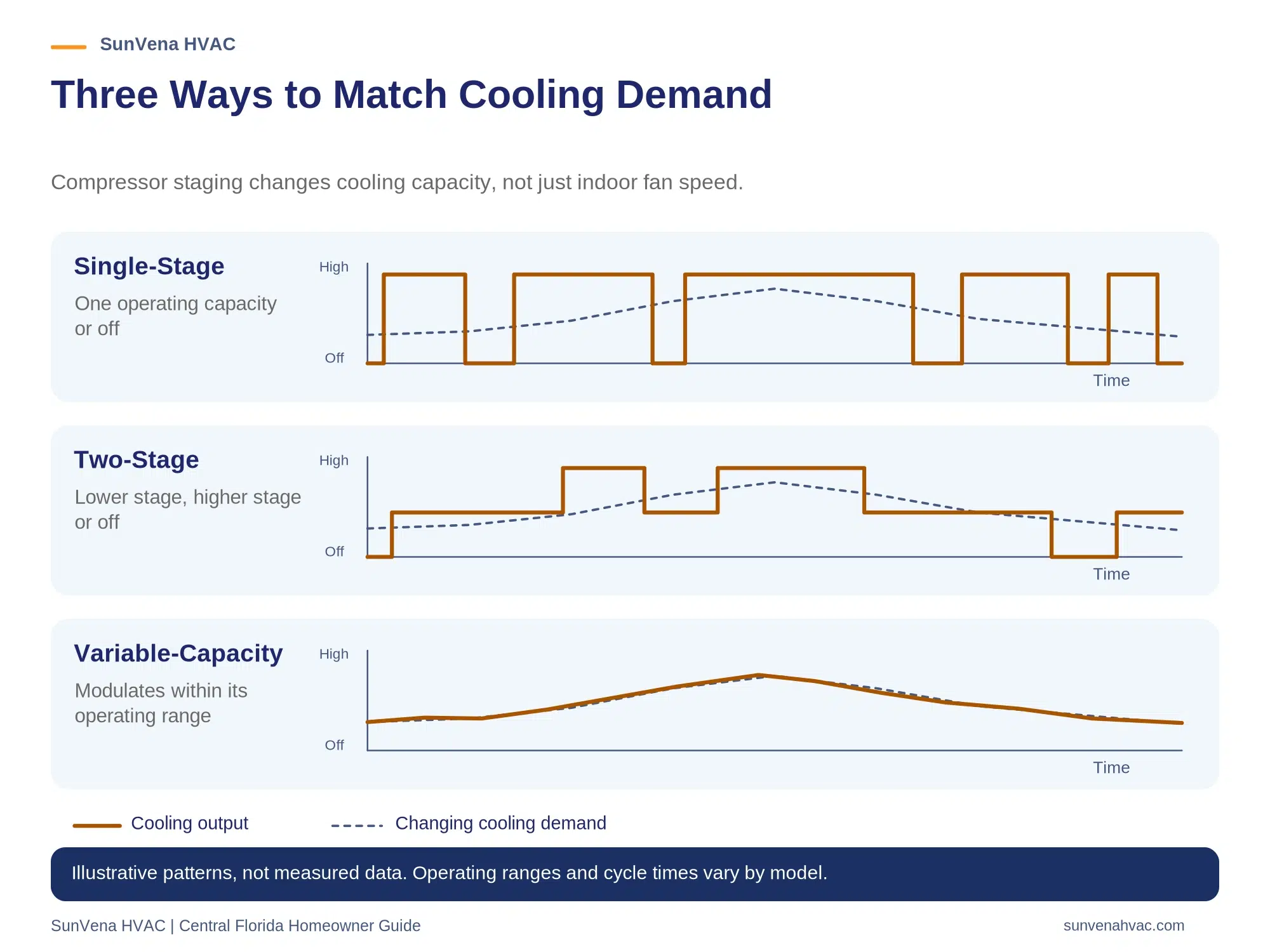
- Staging is about cooling capacity: Single-stage compressors operate at one main cooling capacity, two-stage systems add a lower capacity level, and variable-capacity inverter systems can modulate across a broader operating range.
- Central Florida humidity makes part-load performance important: Longer cooling cycles at lower output can improve moisture removal and temperature consistency when the equipment is properly sized and configured.
- Variable-speed does not automatically mean better for every home: The best system depends on the home’s sensible and latent loads, ductwork, comfort goals, expected ownership, controls, warranty, and installed price.
- Sizing comes before staging: ENERGY STAR and ACCA both warn that oversized equipment can short cycle and provide poor humidity control. A Manual J load calculation should guide equipment selection.
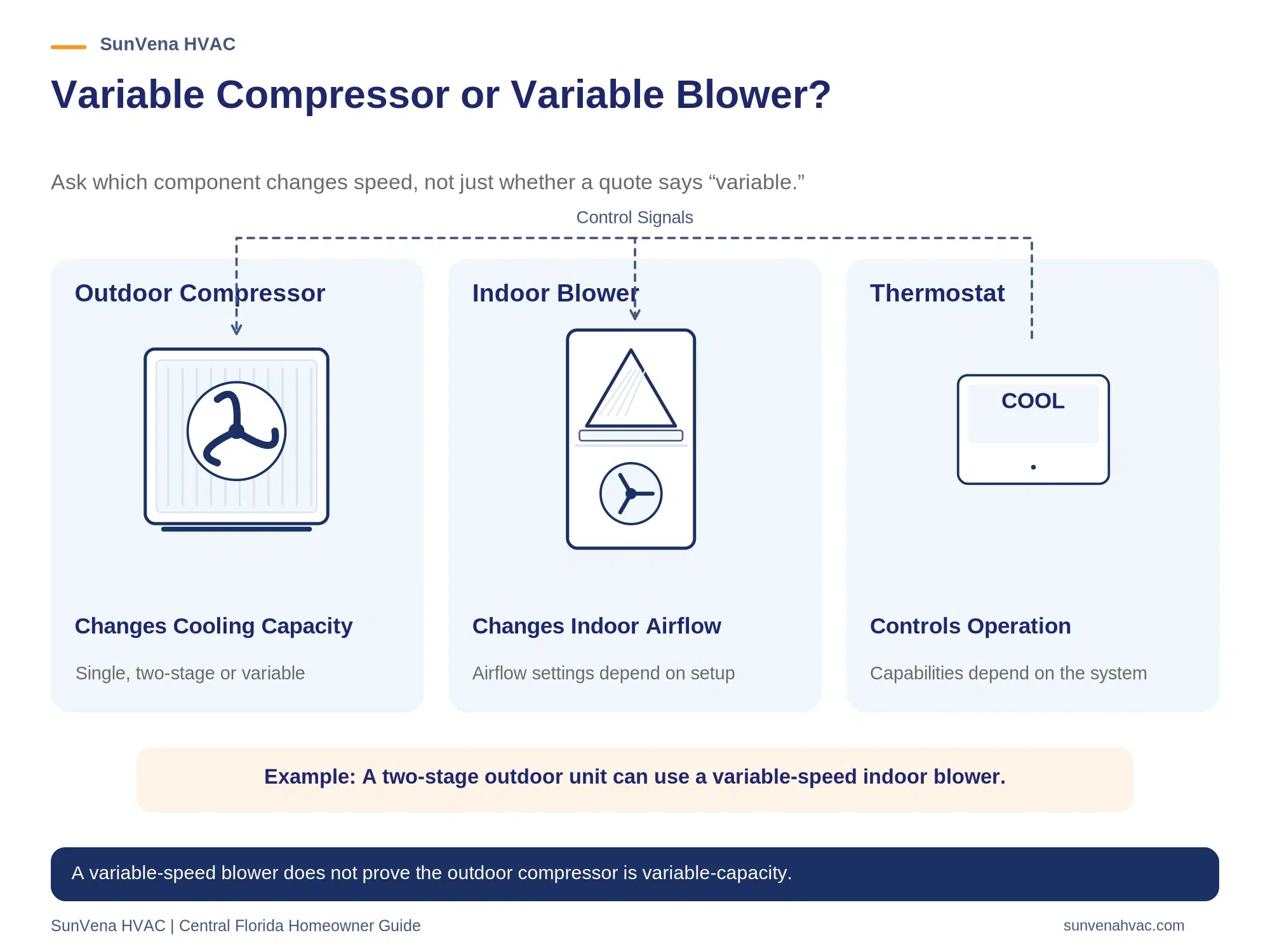
- Do not confuse compressor staging with blower speed: A variable-speed indoor blower can be paired with different compressor types. Ask what the outdoor compressor actually does, not just whether the quote says “variable-speed.”
- Ducts and installation can erase premium-equipment advantages: Restricted airflow, high static pressure, duct leakage, poor refrigerant charging, or incorrect control setup can limit comfort and efficiency at any equipment tier.
For many Central Florida homes, two-stage or variable-capacity air conditioning can provide better temperature consistency and humidity control than a comparable single-stage system, but there is no universally best tier. A correctly sized and installed single-stage system can be a sensible, comfortable choice. Two-stage equipment adds part-load operation without the full cost or complexity of an inverter system. Variable-capacity equipment offers the widest modulation range and can provide excellent comfort and moisture control when the home, ducts, controls, and installation support it.
The decision should come after the load calculation, not before it. Central Florida’s long cooling season and high latent moisture load make runtime and dehumidification especially important, but premium staging cannot compensate for an oversized system, restrictive ducts, poor airflow, or a bad installation.
What Is the Difference Between Single-Stage, Two-Stage, and Variable-Capacity AC?
The terms describe how the compressor changes cooling capacity as the home’s load changes.
| System Type | How Cooling Capacity Changes | Typical Strength | Main Trade-Off |
|---|---|---|---|
| Single-stage | Compressor is generally either running at its designed stage or off | Lowest upfront cost and straightforward operation | Less ability to match lower cooling loads without cycling off |
| Two-stage | Uses a lower cooling stage plus full-capacity operation | Longer part-load cycles and improved comfort without full inverter complexity | Higher installed cost and less modulation than variable-capacity equipment |
| Variable-capacity / inverter | Compressor output can adjust across multiple steps or a broad operating range, depending on the model | Precise part-load operation, temperature stability, quieter low-output operation, and strong humidity-control potential | Highest upfront cost and more model-specific electronics, controls, and service requirements |
The exact percentages are model-specific. Carrier, for example, describes many two-stage systems as operating around 65 percent capacity on low stage, while current variable-capacity Carrier equipment can modulate through a much wider range. Daikin inverter systems likewise adjust compressor output to match the home’s changing cooling demand. Those numbers should not be treated as universal specifications for every manufacturer.
Is “Variable-Speed AC” the Same as a Variable-Speed Blower?
No. This is one of the most important distinctions to make when comparing HVAC quotes.
HVAC companies and manufacturers sometimes use “variable-speed” to describe different components:
- Variable-capacity or inverter compressor: The outdoor compressor changes its cooling output.
- Variable-speed indoor blower: The air-handler or furnace blower can operate at different airflow rates.
- Communicating system: Indoor equipment, outdoor equipment, and the thermostat or system controller exchange more detailed operating information.
A system can have a variable-speed indoor blower without having a variable-capacity compressor. A two-stage outdoor unit may be paired with a variable-speed air handler. Some premium inverter systems combine variable compressor capacity, variable indoor airflow, and communicating controls.
When a proposal says “variable-speed,” ask: Is the compressor variable-capacity, is only the indoor blower variable-speed, or are both variable?
Why Does Staging Matter for Humidity in Central Florida?
Air conditioners remove both sensible heat, which changes air temperature, and latent heat, which represents moisture in the air. Moisture condenses on the cold evaporator coil while the cooling system operates and then drains away through the condensate system.
ENERGY STAR’s HVAC quality-installation guidance warns that oversized equipment can cycle too frequently, reducing comfort, and that poor system airflow can contribute to overly damp indoor air. ENERGY STAR’s right-sizing guidance also explains that short cooling cycles can reduce the amount of moisture that condenses and drains from the coil.
Part-load equipment can help because it can often run longer at lower capacity instead of satisfying a modest cooling load with repeated full-output cycles. Carrier describes its two-stage equipment as using lower-capacity operation for longer periods and its variable-capacity equipment as extending lower-speed operation for enhanced humidity removal. Daikin similarly explains that inverter systems can run at lower output for longer periods to improve humidity management in hot, humid climates.
That makes staging especially relevant in Central Florida, but compressor staging is only one part of humidity control.
Does Variable-Capacity AC Always Remove More Humidity?
No single equipment label guarantees the humidity level in a particular home.
Variable-capacity equipment generally provides more operating flexibility for moisture control, but actual dehumidification also depends on:
- Correct equipment sizing
- The home’s sensible and latent cooling loads
- Indoor blower airflow
- Evaporator-coil design and temperature
- Thermostat and control configuration
- Equipment-specific dehumidification modes
- Duct leakage, especially ducts located outside conditioned space
- Outdoor-air infiltration
- Ventilation settings
- Refrigerant charge
- Drainage and condensate performance
An oversized variable-capacity system may be more forgiving than an oversized single-stage system because it can reduce output, but modulation is not a substitute for proper design. The equipment still has a minimum capacity, and a system that cannot reduce output enough for the home’s actual load can still cycle.
For a deeper explanation of sensible and latent cooling, see SunVena’s guide to how central air conditioning controls temperature and humidity.
Why Does Manual J Matter Before Choosing an AC Stage?
Staging should be selected after the home’s cooling load is understood.
ACCA Manual J is the recognized residential method for calculating heating and cooling loads. The calculation considers factors such as windows, orientation, insulation, infiltration, occupancy, construction, and local design conditions instead of sizing the system from square footage alone.
ENERGY STAR warns that oversized equipment may cycle too frequently, resulting in less comfort and potentially shorter equipment life. ACCA also emphasizes that oversizing can cause short cycling and inadequate moisture removal, a particularly important concern in humid climates.
SunVena’s Central Florida AC sizing and Manual J guide explains why a replacement should not automatically copy the old system’s tonnage.
Is Single-Stage AC a Bad Choice for Central Florida?
No. A single-stage system can be an appropriate choice when it is correctly sized, properly installed, matched to the duct system, and aligned with the homeowner’s budget and comfort expectations.
Single-stage equipment is worth considering when:
- Lowest installed cost is an important priority
- The home has a relatively straightforward load profile
- The duct system is in good condition
- The equipment is accurately sized
- The homeowner is satisfied with conventional temperature and humidity control
- The ownership horizon does not justify a large premium for higher-tier equipment
The limitation is flexibility. When the home’s cooling demand is far below peak design load, a single-stage compressor generally cannot reduce its cooling output. It cycles off instead. How much that matters depends heavily on sizing, thermostat controls, airflow, the building envelope, and the particular Central Florida home.
When Does Two-Stage AC Make Sense?
Two-stage equipment provides an intermediate option between conventional single-stage and fully modulating inverter systems.
During moderate cooling loads, the system can operate at its lower stage rather than immediately using full output. When outdoor conditions or indoor load increase, it can shift to the higher stage.
Potential benefits include:
- Longer cooling cycles during part-load conditions
- Improved temperature consistency
- Better humidity-control potential than comparable single-stage equipment
- Quieter operation while running at lower stage
- Higher efficiency potential, depending on the specific matched equipment
- Lower upfront cost than many premium variable-capacity systems
Two-stage is often a useful option for Central Florida homeowners who want better part-load comfort without paying for the most advanced inverter platform. Whether it is the best value depends on the actual price difference between the specific systems being quoted.
When Is Variable-Capacity AC Worth Considering?
Variable-capacity equipment deserves a closer look when comfort, humidity management, quiet operation, or part-load efficiency is a high priority and the homeowner expects to remain in the home long enough to value those benefits.
It can be particularly attractive when:
- The home experiences significant changes in cooling load throughout the day
- Humidity control is a persistent comfort priority
- The homeowner values small temperature swings
- Quiet low-output operation is important
- The system will have substantial annual cooling runtime
- The duct system can support the equipment’s airflow requirements
- The homeowner understands the controls, warranty, and repair-cost differences
Daikin describes its inverter technology as automatically adjusting compressor speed to match changing heating or cooling demand, with extended lower-speed operation supporting humidity control in hot, humid climates. Carrier likewise markets variable-capacity systems for more precise temperature control and longer low-output operation.
Those are legitimate technical advantages, but they do not mean variable-capacity is automatically the financially best option for every Central Florida homeowner.
Does Variable-Capacity AC Always Save More on Electricity?
Variable-capacity systems are often available at higher SEER2 ratings and can operate efficiently at part load, but staging alone does not tell you exactly how much a particular homeowner will save.
Annual operating cost depends on:
- The SEER2 and EER2 ratings of the specific matched system
- Existing equipment efficiency and condition
- Correct sizing
- Central Florida weather and annual runtime
- Thermostat settings
- Indoor humidity targets
- Duct leakage and static pressure
- Home insulation and air leakage
- Utility rates
- Occupancy and lifestyle
A high-efficiency variable-capacity system replacing an old inefficient unit may produce meaningful savings. The difference between a new two-stage system and a new variable-capacity system may be much smaller. Compare the actual AHRI-rated systems and installed prices rather than assuming the premium equipment will automatically pay for itself.
SunVena’s SEER and SEER2 guide explains how cooling-efficiency ratings should be interpreted when comparing Central Florida replacement options.
Are Variable-Capacity AC Systems Less Reliable?
There is not a sound universal rule that variable-capacity systems fail more often or less often than single-stage systems.
The technology is different. Premium inverter systems use components such as inverter drive electronics, sensors, ECM motors, control boards, and sometimes communicating thermostats. Those parts can be more expensive or model-specific when a failure occurs outside warranty.
At the same time, inverter systems can avoid some of the repeated full-output starts associated with conventional cycling equipment. Manufacturers such as Daikin cite smoother modulation as a durability benefit for their inverter platforms.
The practical homeowner questions are more useful than trying to predict which architecture will fail first:
- How long are the parts and labor warranties?
- Does warranty registration need to be completed?
- How available are replacement controls and inverter components?
- Does the contractor regularly service this specific equipment family?
- What does an out-of-warranty inverter board, compressor, blower motor, or communicating thermostat cost?
- What surge protection is appropriate for the equipment?
SunVena currently advertises 12-year parts, labor, and system-replacement warranties on its air-conditioning services. Eligibility and exact terms should be confirmed for the equipment and installation being quoted.
Do Variable-Capacity Systems Need Surge Protection?
Surge protection is worth discussing for any modern HVAC system, especially equipment with expensive electronic controls, but it should not be described as mandatory unless required by the equipment manufacturer, electrical code, or installation specification.
A surge protective device can reduce exposure to transient voltage spikes. It cannot guarantee that an air conditioner will survive every electrical event, and it does not correct low voltage, sustained overvoltage, wiring faults, bad grounding or bonding, or a direct lightning strike.
Central Florida’s frequent thunderstorms make electrical protection a sensible part of an AC replacement discussion. SunVena’s guide to an AC that trips the breaker also explains the difference between overcurrent protection and surge protection.
Will a Variable-Capacity AC Work With Your Existing Thermostat?
It depends on the equipment.
Some variable-capacity systems are designed around manufacturer-specific communicating controls. Others can operate with certain conventional thermostats or control interfaces, sometimes with reduced access to advanced modulation, humidity, diagnostics, or staging features.
Daikin’s current FIT inverter equipment, for example, is designed to integrate with Daikin communicating controls. Other manufacturers use their own control strategies.
Before choosing a system, ask:
- Is a new thermostat or communicating controller required?
- Which features are lost if a non-communicating thermostat is used?
- Does humidity control require a specific thermostat or wiring configuration?
- Can the equipment operate properly if internet service is unavailable?
- What does the replacement controller cost outside warranty?
The thermostat should be part of the equipment proposal rather than appearing as a surprise after the system is selected.
Why Does Ductwork Matter More as Equipment Gets More Advanced?
Premium equipment still depends on the duct system to move the correct amount of air through the home.
ENERGY STAR identifies proper system airflow as a core part of HVAC quality installation and notes that poor airflow can reduce efficiency, increase utility costs, worsen comfort, and contribute to damp indoor conditions.
Before spending more for staging, it is worth checking for:
- Excessive total external static pressure
- Dirty or overly restrictive filters
- Undersized return ducts or grilles
- Crushed, kinked, disconnected, or leaking flex duct
- Poorly balanced branch ducts
- Air-handler and coil pressure drop
- Ducts in unconditioned attic space with damaged insulation
Not every replacement requires a complete duct redesign. The level of testing should match the home’s symptoms and the condition of the existing system. But a contractor should not assume premium equipment will solve airflow problems that have never been evaluated.
How Should You Compare Single-Stage, Two-Stage, and Variable-Capacity Quotes?
Ask for more than the equipment tier and monthly payment.
| What to Compare | Why It Matters |
|---|---|
| Manual J design load | Shows whether the proposed capacity is appropriate for the home rather than based on old tonnage or square footage alone |
| Compressor type and modulation range | Clarifies whether the outdoor unit is actually single-stage, two-stage, multi-stage, or inverter-driven |
| Indoor blower type | Separates compressor staging from variable indoor airflow |
| AHRI-rated matched system | Provides the certified capacity, SEER2, EER2, and other performance information for the actual indoor and outdoor combination |
| Humidity-control features | Shows whether the system merely modulates capacity or also changes airflow and uses dedicated dehumidification logic |
| Thermostat and controls | Determines what functionality the equipment can actually use |
| Duct and airflow condition | Premium staging cannot overcome a restrictive or badly leaking distribution system |
| Parts, labor, and system warranty | Advanced components can be expensive outside warranty, so coverage changes the long-term risk |
| Complete installed price | Allows the comfort and efficiency benefits to be weighed against the actual upgrade premium |
Which AC Type Is Best for Your Central Florida Home?
There is no universal winner, but these profiles are useful starting points.
Single-Stage May Fit Best If:
- Upfront price is the dominant concern
- The home has a straightforward load and good ductwork
- The equipment can be accurately sized
- You are comfortable with conventional temperature and humidity performance
- You prefer a simpler equipment package
Two-Stage May Fit Best If:
- You want better part-load comfort without moving to the highest equipment tier
- Humidity and temperature consistency matter
- The price premium over single-stage is reasonable
- You want lower-stage operation for much of Central Florida’s cooling season
Variable-Capacity May Fit Best If:
- Humidity management is a high priority
- You value precise temperature control and quieter operation
- The home has long annual cooling runtime
- You plan to stay in the home long enough to benefit from the comfort investment
- The ducts, controls, and installation will support the equipment
- The warranty and future service costs are acceptable
Those are decision profiles, not rules. A high-quality installation of the “lower” tier can outperform a poorly designed installation of the premium tier.
Frequently Asked Questions
Is variable-capacity AC worth it in Central Florida?
It can be. Central Florida’s long cooling season and high humidity create favorable conditions for the longer, lower-output operation that inverter systems can provide. The value is strongest when humidity control, quiet operation, temperature stability, and part-load efficiency matter to the homeowner. Compare the actual upgrade price and system ratings rather than assuming it will automatically pay for itself.
Is two-stage AC better than single-stage for humidity?
Two-stage systems generally have better humidity-control potential because they can operate at lower capacity for longer periods during moderate loads. Actual indoor humidity still depends on sizing, airflow, controls, duct leakage, infiltration, and the specific equipment combination.
Is single-stage AC okay for Central Florida?
Yes. A properly sized and installed single-stage system can cool and dehumidify a Central Florida home effectively. It simply has less ability to adjust its cooling output as the home’s load changes than staged or inverter equipment.
Does variable-speed mean the compressor and blower are both variable?
Not necessarily. “Variable-speed” may refer only to the indoor blower. Ask whether the outdoor compressor is single-stage, two-stage, or variable-capacity and whether the indoor blower is fixed, multi-speed, or variable-speed.
Can variable-capacity AC compensate for oversizing?
It can reduce output and may tolerate some mismatch better than a single-stage system, but it cannot make sizing irrelevant. Every variable-capacity system has a minimum operating capacity. Manual J and proper equipment selection still come first.
Does a variable-capacity AC need a communicating thermostat?
Some do, while others can operate through different control strategies. Advanced humidity, modulation, diagnostics, or comfort features may require the manufacturer’s communicating controller. Confirm the thermostat and available functions before signing the proposal.
Do variable-capacity air conditioners cost more to repair?
Some inverter boards, communicating controls, ECM motors, sensors, and proprietary components can be more expensive than comparable conventional components. That does not prove the equipment will fail more frequently. Compare warranty coverage, parts availability, contractor familiarity, and likely out-of-warranty repair costs.
Should I upgrade the ducts when installing variable-capacity AC?
Not automatically. The existing duct system should be evaluated for airflow, static pressure, leakage, return capacity, and physical condition. Repair or redesign is warranted when measurements or inspection show the ducts will limit the new system’s performance.
Compare AC Replacement Options in Central Florida
SunVena HVAC installs single-stage, staged, and high-efficiency inverter cooling systems throughout Central Florida. A useful replacement proposal should start with the home’s load and existing duct system, then compare equipment capacity, efficiency, humidity-control features, controls, warranty coverage, and installed cost.
Homeowners can review local HVAC installation information for Orlando and Sanford, or explore SunVena’s complete Central Florida HVAC service area.
To compare replacement systems, visit SunVena’s AC installation and replacement services or schedule an HVAC consultation online. You can also call (321) 621-5156.